So, Mr. Limited Government, what should we do about the budget shortfall in Texas?
Cut funding for public education, you say. Really? Is that the best option we can come up with? You want to lay off teachers and ease up on class sizes? What kind of message does that send out?
How about reducing the amount the taxpayers spend on security details for the governor when he's not conducting state business? You know, set an example.
In September 2011, Gov. Rick Perry spent almost $400,000 on security details traveling around the country sticking his foot in his mouth and coming in below "Other" in the polls. Since his reelection in 2010, Gov. Goodhair has racked up more than $750,000 in security expenses for his travels outside the Lone Star State.
If Gov. Perry is willing to be so hypocritical when it comes to spending your money, just what the hell do you think you're in store for if he makes it to the White House? He is more than happy to spend your money chasing a pipe dream but he can't be bothered to find money to restore funding to public schools.
So, Gov. Perry, why don't you take a few minutes and explain to us your vision for limited government?
P.S. I understand how you might need to wait for your speechwriters and press people to stop by and drop off your talking points because God knows it's hard work making George W. look like a genius.
Wednesday, December 7, 2011


Tuesday, December 6, 2011
In the eye of Newt
Back in December of last year I wrote a post about a conservative group that recognizes the current right wing mantra of "lock 'em all up," isn't working. The name of the group was Right on Crime. And who is one of the people behind Right on Crime?
If you guessed Newt Gingrich, you are correct.
Only, as the law profs over at Sentencing Law and Policy point out, you'd never know it from the campaign rhetoric.
From the Right on Crime website is a reprint of an editorial written by Mr. Gingrich and Mark Earley about how to cut down on recidivism. I'll include some of the highlights.
What those on the right don't seem to realize is that if you want to lock someone up and throw away the key, someone's got to foot the bill. Either you have to spend more money to run the state or you have to find the funds from someone else's basket.
Another thing the right wingnuts don't seem to think about is what to do with folks once they get out of prison. You can't just turn them back out on the street because they are virtually unemployable due to their criminal record. If you don't offer some type of assistance they will be forced to return to a life of crime just to survive.
Now, of course, the editorial then morphs into an advertisement for (yet another) religion-based organization with its hands out asking the state for funds.
But, aside from the plug, at least someone on the right of the political spectrum is looking beyond mere campaign rhetoric and actually asking how might a problem be solved. I may not care for Mr. Gingrich's politics in general, but, I do applaud his willingness to think outside the box when it comes to the problems in our criminal (in)justice system.
If you guessed Newt Gingrich, you are correct.
Only, as the law profs over at Sentencing Law and Policy point out, you'd never know it from the campaign rhetoric.
From the Right on Crime website is a reprint of an editorial written by Mr. Gingrich and Mark Earley about how to cut down on recidivism. I'll include some of the highlights.
If two-thirds of public school students dropped out, or two-thirds of all bridges built collapsed within three years, would citizens tolerate it? The people of Georgia would never stand for that kind of failure. But that is exactly what is happening all across the U.S. in our prison systems.
Last year, some 20,000 people were released from Georgia’s prisons to re-enter our communities. If trends of the past decade continue, two-thirds of them will be rearrested within three years. That failure rate is a clear and present threat to public safety.
Not only is this revolving door a threat to public safety, but it results in an increasing burden on each and every taxpayer.
What those on the right don't seem to realize is that if you want to lock someone up and throw away the key, someone's got to foot the bill. Either you have to spend more money to run the state or you have to find the funds from someone else's basket.
Just as a student’s success isn’t measured by his entrance into high school but by his graduation, and a bridge’s value isn’t measured by its completion but by its long-term reliability, celebrating taking criminals off the street with little thought to their imminent return to society is foolhardy.
The key to public safety and fiscal sanity is not just getting dangerous people off the streets but also making sure that men and women who eventually leave prison have changed and can stay crime-free on the outside.
Another thing the right wingnuts don't seem to think about is what to do with folks once they get out of prison. You can't just turn them back out on the street because they are virtually unemployable due to their criminal record. If you don't offer some type of assistance they will be forced to return to a life of crime just to survive.
Now, of course, the editorial then morphs into an advertisement for (yet another) religion-based organization with its hands out asking the state for funds.
But, aside from the plug, at least someone on the right of the political spectrum is looking beyond mere campaign rhetoric and actually asking how might a problem be solved. I may not care for Mr. Gingrich's politics in general, but, I do applaud his willingness to think outside the box when it comes to the problems in our criminal (in)justice system.
Fight the clutter!
I know my desk is in there somewhere...

Maybe not quite that bad, but I think it's time for another good cleaning of the ol' office.

Maybe not quite that bad, but I think it's time for another good cleaning of the ol' office.
Monday, December 5, 2011
Book review: Vulture's Picnic
Prince William Sound. Southern Louisiana. The Gulf of Mexico. The Caspian Sea. Ecuador. Nigeria.
In his latest book, Vultures Picnic: In Pursuit of Petroleum, Pigs, Pirates and High Finance Carnivores, investigative journalist Greg Palast takes us on a frenzied world tour of the damage wreaked by the oil companies and financial speculators (or thieves, as the case may be).
 From Houston to New Orleans to Alaska to Liberia to Switzerland, Mr. Palast does as Woodward and Bernstein were told to do in All the President's Men - follow the money.
What follows is a tale of how transnational capital has decimated the lives of the poor across the planet. The oil companies polluted the people and the environment and the vultures of high finance have swooped in and forced foreign governments to kowtow to the will of their corporate overseers. The result of his investigation will open your eyes and make you think twice about what you think you know.
You'll recall that after the Exxon Valdez ran aground that folks cut up their Exxon credit cards, dipped them in oil and mailed them back. My wife refuses to go to an Exxon station to this day. But guess who was really at fault for the disaster in Prince William Sound. Not Exxon. BP - you know the company that portrays itself as green as a hemp-wearing tree hugger - was in charge of the terminal at Valdez. BP was in charge of ensuring that the clean up equipment was there. But guess what? There was no clean up equipment. But, for the good of the Seven Sisters, Exxon bent over and grabbed its ankles.
After the Transocean disaster in the Gulf, it was BP's turn to grin and bear it. But the boys in green weren't the ones making the decisions out there. All of the sisters were supposed to have a plan in place just in case a deep water well went to hell - and, as you know by now, there was no plan.
But what you probably didn't know is that the Transocean disaster wasn't BP's first rodeo. Out in the Caspian Sea, BP used a nitrogen-concrete blend to seal a well and, let's just say that didn't work out so well. But we're sold the line that what happened out in the Gulf was an accident. Once, my friends, is an accident. Twice is a pattern.
And, if you have trouble staying awake late at night, just read the section on the backup diesel generators at nuclear plants around the world. Here's a hint... Mother Nature wasn't to blame for the meltdown at Fukushima.
In his latest book, Vultures Picnic: In Pursuit of Petroleum, Pigs, Pirates and High Finance Carnivores, investigative journalist Greg Palast takes us on a frenzied world tour of the damage wreaked by the oil companies and financial speculators (or thieves, as the case may be).
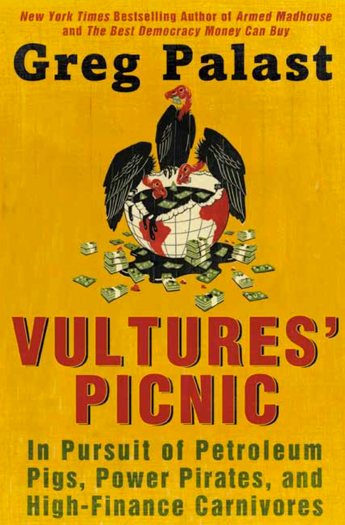 From Houston to New Orleans to Alaska to Liberia to Switzerland, Mr. Palast does as Woodward and Bernstein were told to do in All the President's Men - follow the money.
What follows is a tale of how transnational capital has decimated the lives of the poor across the planet. The oil companies polluted the people and the environment and the vultures of high finance have swooped in and forced foreign governments to kowtow to the will of their corporate overseers. The result of his investigation will open your eyes and make you think twice about what you think you know.
You'll recall that after the Exxon Valdez ran aground that folks cut up their Exxon credit cards, dipped them in oil and mailed them back. My wife refuses to go to an Exxon station to this day. But guess who was really at fault for the disaster in Prince William Sound. Not Exxon. BP - you know the company that portrays itself as green as a hemp-wearing tree hugger - was in charge of the terminal at Valdez. BP was in charge of ensuring that the clean up equipment was there. But guess what? There was no clean up equipment. But, for the good of the Seven Sisters, Exxon bent over and grabbed its ankles.
After the Transocean disaster in the Gulf, it was BP's turn to grin and bear it. But the boys in green weren't the ones making the decisions out there. All of the sisters were supposed to have a plan in place just in case a deep water well went to hell - and, as you know by now, there was no plan.
But what you probably didn't know is that the Transocean disaster wasn't BP's first rodeo. Out in the Caspian Sea, BP used a nitrogen-concrete blend to seal a well and, let's just say that didn't work out so well. But we're sold the line that what happened out in the Gulf was an accident. Once, my friends, is an accident. Twice is a pattern.
And, if you have trouble staying awake late at night, just read the section on the backup diesel generators at nuclear plants around the world. Here's a hint... Mother Nature wasn't to blame for the meltdown at Fukushima.
Saturday, December 3, 2011
Saturday morning run
While y'all are reading this, I'll be running 31 miles through the woods at Huntsville State Park. Have a great day!
Friday, December 2, 2011
First they came for the (alleged) terrorists...
On Tuesday the U.S. Senate had the opportunity to put the rule of law ahead of fear-mongering and politics -- and failed spectacularly.
By a vote of 61-37 the Senate defeated an amendment to the defense appropriations bill that would remove three troubling provisions that have raised the spectre of a presidential veto. The bill, if passed, would allow the U.S. to hold those suspected of involvement with terrorism - including US citizens - indefinitely without charge. In other words, forget about that American concept of innocent unless proven guilty; if los federales suspect you're involved in terrorism, you are guilty unless you can prove otherwise.
The bill would also require civilian law enforcement to turn over anyone suspected of terrorist activities into military custody. The bill would also place further restrictions on the transfer of detainees at Guantanamo who were cleared of all charges.
Holding a suspect indefinitely without bringing charges makes a complete mockery out of our criminal (in)justice system. Without being informed of the specific charges against him, an inmate can't muster a legal defense and his right to a speedy trial is taken away. The very notion of indefinite detention should make us all shudder - but it won't. After all, who's going to raise a stink about someone accused of plotting to blow up a building? He's not a person, he's a terrorist. He has no rights.
But once you've demonized one group of defendants, it makes it easier to demonize the next group. And who will that be? And who will stand up to challenge the state then?
Liberty is a funny creature. We all have the right to be left alone by our government. But, at the same time, that means we can't be protected from every possible threat out there. It's a trade-off we make. The more freedom and liberty you have, the less security you get. And vice versa.
What's more important to you?
When we allow the government to take away our rights - no matter how tangentially - we are allowing the fox into the hen house. There will always be a rationale. C'mon, these are really, really bad people.
It's happened to the Fourth Amendment. Where once we were protected against unreasonable search and seizure, today it's little more than a piece of paper. In the name of security and efficiency we have allowed one of our most important freedoms to be whittled away to nothing.
Today it's suspected terrorists. Who will it be tomorrow?
Thursday, December 1, 2011
You gotta blame someone
Last March protesters took to the streets of Bahrain demanding a voice in the governance of the oil-rich kingdom. Imagine that - in this day and age of democracy busting out all over, we have the vestiges of an era in which someone grabbed a bigger stick and declared himself to be king. How could that cause any problems?
As is wont to happen when an authoritarian regime is challenged, the security forces (providing security for whom?) were whipped into a frenzy and went into a murderous rampage against their own citizens. Now let's just think about that for a moment. Armed personnel (thugs?) in the employ of the government are ordered to beat, maim, intimidate and kill anyone who dare speak out against the regime. The same regime that puts on its smiley face and tells the people to be patient - that reform is in the works.
Nope. Wrong answer. What we have is a government that has lost all legitimacy. Once a regime turns its armed forces on its own citizenry, it has lost whatever moral authority it may have had in the first place. And any member of the security forces (or police or army or whatever the hell you want to call the thugs) that follows an order to turn his weapon on a fellow citizen is guilty of a crime.
But there's more. You see the Bahraini government decided that it wasn't enough to beat, maim and kills its own citizens. After all, the victims who were still breathing had to get medical treatment somewhere. With all apologies to Shakespeare, the king decided the first thing he needed to do was kill the doctors.
Punish the doctors, that's right. Forget about the dead and the wounded. Forget about the army pointing its weapons at the people it's supposed to protect (well, that's what we're told the military and police do - in reality their job is to protect the chosen few.)
Twenty doctors, nurses and medics were convicted of inciting the people to overthrow the government and were sentenced to between five and 15 years in prison. Forget about the soldiers that shot, maimed and killed their fellow citizens - they went back to their barracks and got some commendation or ribbon to pin to their uniforms. But the medics who did what doctors do got the whip.
Maybe some of the medics wanted to see the government overthrown. Maybe some were part of the protests. Who cares? They were tried and convicted for tending to the wounded and trying to save their lives. They were punished for treating the citizens who were injured at the hands of their own government.
Bowing to international pressure (and to an international panel's report that found "abuses" in the government's crackdown on protesters -- I guess you could call killing protesters to be abusive. I prefer to call it murder), the medics were retried on Monday.
Maybe the regime tries to make nice and hope everything blows over. But you can't unring the bell. And, no matter how hard you scrub, you can't wash away the blood on your hands.
Wednesday, November 30, 2011
Surprise! Surprise! Surprise!
What a shock. The day after the local police unions announce they will not endorse current Harris County DA Pat Lykos in the upcoming election, former judge Mike Anderson announces his entry in the race.
Let the games begin...
Police evict Occupy! protesters in LA and Philly
The violent crackdown on Occupy! protesters across the country continued in the early hours of this morning as police in Los Angeles and Philadelphia attacked nonviolent protesters.
Officers dressed in riot gear did their job of protecting and serving their corporate masters by storming through the encampments wielding batons and tearing down tents and other structures. The lasting images of these protests will be peace officers attacking citizens for exercising their First Amendment rights of free speech and petitioning the government to address their grievances.
Over the years the police have been used to break up strikes and attack civil rights protesters and anti-war activists. Police brutality is not the work of a few "bad apples," it is part and parcel of the culture of law enforcement in this country.
Scenes from the police raid in Los Angeles.
Philadelphia police clear encampment.
Spamming for dollars
I received some spam an unsolicited e-mail in my inbox the other day from someone named J. Connor Alexander wanting to write blog posts for me. According to the e-mail, Mr. Alexander has experience writing "snappy" SEO-friendly blogposts and would be more than happy to do the same for me.
Funny, though, that his resume makes no mention of any marketing or SEO jobs.
He also wrote...
Of course when I googled the good Mr. Alexander I found a blog - that hadn't been updated in nearly a year. Is that the kind of hard work and dedication I should expect from him?
The two blog posts he submitted as samples of his work were, how shall I say, pure drek. They read as though they had been taken straight out of a newspaper article and offered no insight - just a regurgitation of someone else's work. He did, however, make sure he included the dreaded call to action paragraph and tried to fit in those precious key search terms whenever possible. The sad thing is he claims the posts were actually published in someone's blog. Egads.
But, then, I'm just a criminal defense attorney - what the hell do I know about this fancy marketing stuff he's trying to sell? I do know that blogs written solely for SEO or marketing purposes are doomed to failure. There's only so many ways you can cram your own key search terms into a blog post. With nothing else to say, what's the freaking point in pounding away at a computer keyboard when you could be playing Angry Birds?
In short, Mr. Alexander, I think I will have to turn down your offer of assistance. You see, I don't crank out blogposts crammed full of key search terms. I don't regurgitate articles in the local newspaper. I write about what I care about and what I find interesting.
So, good luck with your search, I'm sure you'll find some willingvictims suckers attorneys willing to part with their cash for the promise of internet gold.
Funny, though, that his resume makes no mention of any marketing or SEO jobs.
He also wrote...
In the short time I’ve worked in the legal community I’ve come to understand just how important internet referrals can be to a firm’s bottom line. I’ve seen firsthand several firms start and then tire of their efforts to create and sustain a blog. In short order the business of running the firm invariably takes precedence over the blog. As a result, updates become sporadic and the firm’s web presence diminishes. That’s where I hope to come in. I’d love to see to it that every day/week/month you have a new, engaging, topical, search engine optimized post waiting to be published.How short a time you may ask? How about he graduated from law school this past May. According to his resume he worked one summer as a clerk during law school and two summers as an undergrad. But in that time he's made these startling discoveries. Hmm. I wonder if Brian Tannebaum would like to take a run at him.
Of course when I googled the good Mr. Alexander I found a blog - that hadn't been updated in nearly a year. Is that the kind of hard work and dedication I should expect from him?
The two blog posts he submitted as samples of his work were, how shall I say, pure drek. They read as though they had been taken straight out of a newspaper article and offered no insight - just a regurgitation of someone else's work. He did, however, make sure he included the dreaded call to action paragraph and tried to fit in those precious key search terms whenever possible. The sad thing is he claims the posts were actually published in someone's blog. Egads.
But, then, I'm just a criminal defense attorney - what the hell do I know about this fancy marketing stuff he's trying to sell? I do know that blogs written solely for SEO or marketing purposes are doomed to failure. There's only so many ways you can cram your own key search terms into a blog post. With nothing else to say, what's the freaking point in pounding away at a computer keyboard when you could be playing Angry Birds?
In short, Mr. Alexander, I think I will have to turn down your offer of assistance. You see, I don't crank out blogposts crammed full of key search terms. I don't regurgitate articles in the local newspaper. I write about what I care about and what I find interesting.
So, good luck with your search, I'm sure you'll find some willing
Tuesday, November 29, 2011
Speaking for those without a voice
The latest targets of the government's move to shut down the Occupy! protesters are Los Angeles and Philadelphia. In LA, Mayor Antonio Villaraigosa ordered protesters to leave their encampment in front of city hall at 12:01 a.m. Monday morning. Philadelphia mayor Michael Nutter ordered protesters to vacate their encampment by 5:00 p.m. Sunday evening.
As of this posting no one has been forcibly removed from the encampments though some protesters did leave in order to avoid being arrested or having their belongings confiscated.
In both LA and Philly, the mayors have stated that the plazas in front of their respective city halls are scheduled to undergo renovations.
But this isn't about renovating plazas or taking down tents. This is an assault on our First Amendment right to assemble peacefully and air our grievances. The Occupy! protesters aren't camping out. The tents themselves are an expression of speech.
Think that's ridiculous? Well, how about corporate interests arguing before the Supreme Court that making campaign contributions is an expression of speech and that curtailing the ability of corporations to make campaign contributions is a restriction of their First Amendment rights?
A corporation is not a person - and never has been. The rationale for forming a corporation was to limit the owners' liability in case something went wrong. A corporation is incapable of speaking. That's left to directors, officers and shareholders. A corporation can't vote. That's the duty of the directors, officers, shareholders and employees.
Our government is based on the rule of the people. That's you, me and everyone we come into contact with on a daily basis. But, what is has become is a tool of the corporate interests. Our representatives in Washington don't ask themselves what the effect of any given legislation will be on the ordinary folks living in their district - they ask themselves how that legislation will affect the corporate interests back home.
So while corporations bundle up their contributions and buy their congressmen, ordinary folks are left to wonder why their voices aren't heard. Why their concerns aren't addressed. Why no one in Washington seems to give a damn about their lot in life.
They don't have a seat at the table. They don't have a ticket to get into the room. All they can do is camp outside and make their presence known.
And it's because of the money.
Monday, November 28, 2011
Book review: Deadly Monopolies
I just finished reading medical ethicist Harriet Washington's latest book Deadly Monopolies, a look into the world of the pharmaceutical industry.
 Back in the good ol' days, universities and hospitals were the breeding grounds for new medicines. Researchers collaborated in order to find ways to fight common disease. Most new discoveries weren't patented because the research dollars came from the federal government.
That all changed in 1980 with the Bayh-Dole Act that allowed corporations, universities and hospitals to patent their discoveries even if the funding to conduct the research came from US taxpayers. At that moment, medical research ceased to be a race to find the cure and became, instead, a race to lock in profits. When that is factored in along with a newfound ability to patent genes, cell lines and other biological material, big pharmaceutical companies stood to make vast fortunes.
Along the way the concept of "informed consent" was cast aside as it was a hindrance to labs, hospitals and drug companies testing their wares on the public. So much for ethical considerations - we have money to print.
In the United States, hospitals across the country subjected patients to trials involving artificial blood. No one asked these patients if they wanted to participate in the study - if they happened to be taken to the right emergency room in the right city, they received the artificial blood.
The attempt may have been noble - as may have been the trials involving substitutes for saline solution for patients who suffered a traumatic injury in the field - but the method was not. The people who received the artificial blood were never consulted to determine if they minded being guinea pigs. They were never informed of the possible risks involved in pumping the artificial blood into their bodies.
In Africa the drug companies conducted trials of drugs to fight the scourge of AIDS. But there was a catch. In trying to determine how effective the new drugs were in fighting AIDS, the control group in the trial was given a placebo. That's right - some in the study were condemned to die while others received a chance to live.
In this country a test conducted under that dynamic would never be allowed. In order to test the effectiveness of a new treatment, the control group needs to receive the currently accepted standard of care. This gives researchers the ability to compare the effectiveness of the varied treatments. Under no circumstances should a person be allowed to die because he's been given a placebo.
Researchers argued that the trials were ethical because the current accepted standard of care in Africa for AIDS was no treatment at all. And, of course, none of the test subjects were ever told they might be given a placebo rather that the real drug.
If you're not irritated enough at the high cost of health care and prescription medications, after you read Deadly Monopolies, you will be.
Friday, November 25, 2011
Just win, baby
The Longhorns win the final installment of the Lone Star Shootout. And forever's an awfully long time.
Texas Fight, Texas Fight,
And it's goodbye to A&M.
Texas Fight, Texas Fight,
And we'll put over one more win.
Texas Fight, Texas Fight,
For it's Texas that we love best.
Hail, Hail, The gang's all here,
And it's good-bye to all the rest!
And it's goodbye to A&M.
Texas Fight, Texas Fight,
And we'll put over one more win.
Texas Fight, Texas Fight,
For it's Texas that we love best.
Hail, Hail, The gang's all here,
And it's good-bye to all the rest!
(YELL)
Yea Orange! Yea White!
Yea Longhorns! Fight! Fight! Fight!
Texas Fight! Texas Fight,
Yea Texas Fight!
Texas Fight! Texas Fight,
Yea Texas Fight!
As for the Aggies... they'll be going from the 'Horns younger brother to the SEC's little b----.
Thursday, November 24, 2011
Happy Turkey Day
Now that I'm in a charitable mood, I thought I'd give a bit of thanks to everyone who drops by The Defense Rests on a regular (or semi-regular) basis. I hope it gives you something to ponder, to debate and to laugh at occasionally.
I'd also like to thank my fellow bloggers for the work they do and the effort they put into their efforts. If you don't already, please take a look at some of the other writers on my blogroll.
Meanwhile I'll be out on the back patio smoking a turkey over oak and pecan and trying to forget that I'm scheduled to be in trial on Monday.
May you all have a relaxing day with family and friends and forget about a little of the shit we have to deal with on a daily basis.
Wednesday, November 23, 2011
$o much for tradition

You see, Texas A&M, that university that prides itself on "tradition," decided to walk away from the Big 12 and join the SEC beginning in 2012. For those of y'all like me, who grew up watching the old Southwest Conference, it's hard to comprehend. The Aggies are walking away from tradition for a few dollars more. The joke will be on them when the bills for sending the women's soccer team to South Carolina or the baseball team to Florida on a regular basis.
The SEC sold the Ags a bill of goods. Let's be real, there aren't any kids from Georgia or Tennessee or Alabama who are clamoring to move to College Station to play football. What the SEC wanted was unfettered access to Texas recruits. Currently the only SEC school that does much recruiting in Texas is LSU - but they're practically family.
When the Big 12 damn near imploded a year ago, A&M was one of the schools that benefited the most as the exit fees paid by Colorado and Nebraska found their way into the coffers in Austin, College Station, Norman and Stillwater. A&M signed off on that deal knowing full well that UT was going to launch the Longhorn Network. So, using the LHN as an excuse for leaving for the SEC is a canard the A&M administration figured their loyal followers wouldn't question.

And now the nation's third longest rivalry is coming to an end. And it sucks. I grew up with this game. Often times Thanksgiving dinner was scheduled around it. Before my oldest daughter was born I took my wife up to Austin to watch the game. My oldest daughter's been to Kyle Field twice to watch the 'Horns beat the Ags.
Here's hoping the 'Horns send the Ags running off with their tails between their legs.
Hook 'em!
A river runs dry
Here's an idea of just how bad the drought has been in Texas this year. This is a picture I took the other day of the Navidad River as I was driving down to Jackson County. The red grass in the picture is where the water used to be. The river has been reduced to a stream.

The Navidad River bottom is also the home of the Wild Man of the Navidad.

The Navidad River bottom is also the home of the Wild Man of the Navidad.
Tuesday, November 22, 2011
Blawgroll
From the Char Bar in scenic downtown Houston on a warm November Monday afternoon...

It was a veritable blawgroll in the unofficial haunts of the Harris County Criminal Lawyers Association. In the back row we've got Murray Newman, Franklin Bynum, Mark Bennett, Marvin Lewis, Jr. and Jackie Carpenter. In front it's yours truly, Mirriam Seddiq and one of the newest members of the Texas Bar, Jessica Day.

It was a veritable blawgroll in the unofficial haunts of the Harris County Criminal Lawyers Association. In the back row we've got Murray Newman, Franklin Bynum, Mark Bennett, Marvin Lewis, Jr. and Jackie Carpenter. In front it's yours truly, Mirriam Seddiq and one of the newest members of the Texas Bar, Jessica Day.
I'd like to buy a vowel, please
If you're going to carve your name in the wet concrete for all posterity -- you might want to get the spelling right.


Monday, November 21, 2011
Standing by and twiddling their thumbs
The atrocities committed by UC-Davis police have been covered excellently by more than a few of my colleagues. The entire incident seems almost surreal and worthy of condemnation.
With the news that two of the officers have been suspended, my only question is whether they were suspended for what they did or for bringing embarrassment upon the department. But for video, would these men have faced any sanction at all?
The arrogance of, Lt. John Pike, the cop who waved the cannister above his head before unloading, makes my stomach turn. None of those kids deserved to get that shit sprayed in their face. They were just sitting there blocking a sidewalk.
Were these officers just "rotten apples?" Or are they the face of the police? Are the police here to protect and serve or are they here to make sure that the have-nots don't get out of line? Is it their job to prevent chaos from breaking out or is it their job to quell dissent by whatever means necessary?
I can tell you that what happened at UC-Davis is not some isolated incident. It just happened to be performed in front of a bunch of kids armed with smart phones and an internet connection. What happens when the cameras aren't rolling? What happens when it's the word of the cop versus the word of the person he arrested for (fill-in-the-blank)?
What makes it worse is that no one stopped him from unleashing the pepper spray into the faces of those kids. Not one other officer had the guts to stand up and do the right thing. They just stood and watched.
That's the scary part.
See also:
- "The kids on your baseball team," Simple Justice (Nov. 20, 2011)
- "UC Davis: perfectly reasonable, completely wrong," Simple Justice (Nov. 20, 2011)
- "UC Davis: sauce for the gander," Defending People (Nov. 20, 2011)
- "Because the proper response to 'jump' is 'how high': The UC Davis edition," Gamso for the Defense (Nov. 20, 2011)
- "It's time for a national conversation on law enforcement," Criminal Defense Blog (Nov. 20, 2011)
Do as I say, not as I do
So, you want to take advantage of some information you obtained as a result of your position to make some money in the stock market? Some information that ordinary members of the public are privy to?
If you work in the private sector, just pack your toothbrush if you do because los federales will throw the book at you. Nevermind that markets operate on imperfect information and those who make money do so because they're able to take advantage of the information gap.
We can't have corporate executives taking advantage of their inside information to turn a buck on Wall Street, can we? Putting their own financial interest above that of the company they were hired to run - that just won't do.
But, if you are a sitting member of Congress, by all means, trade away. Gather up all the information you can at that subcommittee meeting. Take notes when that guy from Treasury gives you a briefing. Figure out who's going to win, and who's going to lose, under the terms of that proposed bill.
It's all okay.
After all, the rules that apply to the rest of us don't apply to the 535 men and women in Congress. Or, if they do, they sure as hell aren't applied the same way.
Take insider trading, for instance. There is no statute that makes trading on inside information illegal. Rather, when los federales charge someone with securities fraud, the allegation is generally either that the defendant breached a duty to the source of the information or to the person he traded with.
Of course congressmen have a duty, too. It's a fiduciary duty to act in the best interest of the United States of America - not in the best interests of the representative from some little town in Iowa. But when congressmen trade on the basis of information they've received solely because they're in Congress, they are violating that duty.
Now, thanks to a recent piece on 60 Minutes, the tide is turning. With congressional popularity at an all-time low, there really was no other choice. Now, for the first time since legislation was introduced in 2006, Congress looks to be on the verge of passing legislation that will ban members from trading on information obtained through their role as congressmen.
It is what it is
So which is it?


Is it $10 in the morning...

...or is it $5?
This is the kind of crap people going to the municipal courthouse to fight traffic tickets have to deal with.
Friday, November 18, 2011
Defending the indefensible
The other night (at yet another televised "debate") three GOP presidential hopefuls, Herman Cain, Michele Bachmann and our own Rick Perry, voiced their support for torture. Mr. Perry even went so far as to say waterboarding was an "enhanced interrogation technique."
Arizona Senator John McCain had the courage to say what few in the GOP (aside from Ron Paul) are willing to:
At least that's the way in which the question is framed. But I don't care how you frame the question. Torture is wrong. It's demeaning, both to the person being tortured and to the person carrying out the torture.
The use of torture is an example of what Jeff Gamso would call "the Law of Rule." It is a fundamental affront to our notion of justice. If it's okay to torture alleged terrorists, how much of a reach is it to justify torture with someone accused of kidnapping a little child?
The use of torture is a violation of a suspect's Fifth Amendment right to remain silent. It violates the Geneva Convention. Members of the German and Japanese hierarchy were hung after World War II for their use of torture during the war.
From the mind of Gene Roddenberry, here is a transcript from the Star Trek: Next Generation episode entitled "Chain of Command, Part 2" that aired in December 1992. In this episode, Capt. Picard was taken prisoner by the Cardassians and taken to a secret location for interrogation by Gul Madred.
We're better than torture. Those who defend it are appealing to the lowest common denominator in our electorate. In the race to the bottom, Cain, Bachmann and Perry have the inside track.
Arizona Senator John McCain had the courage to say what few in the GOP (aside from Ron Paul) are willing to:
"Waterboarding is an affront to all of the standards that we believe in and adhere to of humane treatment of people who are human beings, and of course I am disappointed in the statements that were made," said McCain on CNN's "John King USA" Monday.
McCain argued that waterboarding is illegal, harms the United States’s moral standing in the world and doesn't help gather reliable intelligence.Of course no one likes terrorists and who really gives a shit if you torture them to extract information? They're not even human, right?
At least that's the way in which the question is framed. But I don't care how you frame the question. Torture is wrong. It's demeaning, both to the person being tortured and to the person carrying out the torture.
The use of torture is an example of what Jeff Gamso would call "the Law of Rule." It is a fundamental affront to our notion of justice. If it's okay to torture alleged terrorists, how much of a reach is it to justify torture with someone accused of kidnapping a little child?
The use of torture is a violation of a suspect's Fifth Amendment right to remain silent. It violates the Geneva Convention. Members of the German and Japanese hierarchy were hung after World War II for their use of torture during the war.
From the mind of Gene Roddenberry, here is a transcript from the Star Trek: Next Generation episode entitled "Chain of Command, Part 2" that aired in December 1992. In this episode, Capt. Picard was taken prisoner by the Cardassians and taken to a secret location for interrogation by Gul Madred.
MADRED: Oh, you're awake. Have something to eat. I insist. Boiled taspar egg. It's a delicacy I'm happy to share with you.
(Madred gives Picard a knife to slice the top off the very large egg, but this one isn't boiled. The contents are still alive and moving. Picard downs it in one)
MADRED: Wonderful. Wonderful. I like you, human. Most people become ill at the sight of live taspar. I remember the first time I ate a live taspar. I was six years old and living on the streets of Lakat. There was a band of children, four, five, six years old, some even smaller, desperately trying to survive. We were thin, scrawny little animals, constantly hungry, always cold. We slept together in doorways, like packs of wild gettles, for warmth. Once, I found a nest. Taspars had mated and built a nest in the eave of a burnt-out building and I found three eggs in it. It was like finding treasure. I cracked one open on the spot and ate it, very much as you just did. I planned to save the other two. They would keep me alive for another week. But of course, an older boy saw them and wanted them, and he got them. But he had to break my arm to do it.
PICARD: Must be rewarding to you to repay others for all those years of misery.
MADRED: What do you mean?
PICARD: Torture has never been a reliable means of extracting information. It is ultimately self-defeating as a means of control. One wonders that it's still practiced.
MADRED: I fail to see where this analysis is leading.
PICARD: Whenever I look at you now, I won't see a powerful Cardassian warrior. I will see a six year old boy who is powerless to protect himself.
MADRED: Be quiet.
PICARD: In spite of all you've done to me, I find you a pitiable man.
MADRED: Picard, stop it, or I will turn this on and leave you here in agony all night.
PICARD: Ah! You called me Picard.
MADRED: What are the Federation's defence plans for Minos Korva?
PICARD: There are four lights. (Madred uses the agoniser.)
MADRED: There are five lights. How many do you see now?
PICARD: (in agony) You are six years old. Weak and helpless. You cannot hurt me.
MADRED: How many?
PICARD: Sur le pont d'Avignon, on y danseFear has never been an effective tool of control. In order for it work, the level of fear must be ramped up constantly. In regimes across the Middle East and Africa, those dictators who held onto power through their use of fear have either been force out or are hanging on by their fingertips. All the use of fear did was fuel dissent - and once that dissent reached a critical mass, the game was up.
We're better than torture. Those who defend it are appealing to the lowest common denominator in our electorate. In the race to the bottom, Cain, Bachmann and Perry have the inside track.
Go west, young man
In 1962 Major League Baseball came to Houston with the birth of the Colt .45's. A corner of the (now) Reliant Stadium parking lot was home to Colt Stadium.
In 1965 the (newly renamed) Astros moved into the 8th Wonder of the World - The Astrodome where they stayed until 2000 when they moved downtown to the newly built Enron Stadium. After the collapse of Enron the ballpark's naming rights were sold to Minute Maid.
From those humble beginnings in the sweltering Houston heat in 1962 through the disastrous 2011 campaign, the Astros battled for supremacy in the National League. They reached the playoffs for the first time in 1980 but lost in five games in the NLCS to the Phillies. They made it back to the playoffs again in 1986, losing to the Mets in six games -- the last of which was a 16-inning classic.
In 2005 the Astros finally made it to the World Series and celebrated by getting swept by the White Sox.
Now it's time to throw all that history out the window because Major League Baseball has decided that the Astros need to move from the National League to the American League in order to balance the divisions. In order to entice the Astros to agree to the move, MLB is paying Jim Crane, the new Astros' owner a total of $70 million (half of it from Drayton McLane). More to the point, MLB told Mr. Crane they wouldn't approve the sale without an agreement that the Astros would move. Of course, there may be a stumbling block.
If moving from the NL Central to the AL West is such a damn good idea - why is Jim Crane being paid $70 million to agree to it? If having the Yankees and Red Sox come to town every year is such a boon to the bottom line, why is Jim Crane being given $70 million back?
And why move the Astros? The Astros have played in the NL for the last 49 years. Why not the Arizona Diamondbacks? They've only been around since 1998? Their fan base is transitory and largely disinterested in baseball. And, hell, Phoenix is further west than Houston.
Why not Milwaukee? They've only been around since 1969. They played in the AL through the 1997 season. I understand they're in the Midwest -- but so what?
I love baseball. I love to root for the Astros. I hate the Yankees and I hate the Red Sox. But I also believe that NL baseball is truer to the spirit of baseball than that game they play in the AL. I believe the designated hitter is one of the worst abominations of our time. I think using a DH takes too much of the strategy out of the game.
Of course it won't matter in the end because one of these days the DH will be expanded to the NL, too. Just think about it, that means 15 more aging, out-of-shape veterans who no longer have the skills to play in the field will be able to collect a large paycheck. That will be the death of baseball.
The Astros have a proud history. Over the years the Astros have had heated rivalries with the Dodgers, Braves, Mets and Cardinals. Those days are about to be over -- all for a few dollars. It's bad enough that colleges are walking away from traditional rivalries all in the name of money; but now we're talking about our national pastime.
It's a bad move. Watching the Astros play won't ever be the same again.
Thursday, November 17, 2011
The sins of the father?
What does it mean to have criminal intent?
What does it mean to be a psychopath?
Dr. Kent Kiehl of the University of New Mexico has a theory.
Dr. Kiehl is a neuroscientist specializing in the cutting edge field of behavioral neuroscience. Dr. Kiehl believes that psychopathic behavior is "hard-wired." In other words, those who commit criminal acts yet show no emotion or empathy aren't evil, they're suffering from a disorder of the brain.
Dr. Kiehl's lab has customized a van with a mobile brain scanner that allows him to drive it into prisons to conduct research. His research seems to indicate that psychopaths have low density levels and low activity levels in the para-limbic systems in their brains.
And that's where Dr. Kiehl's theory becomes very interesting.
Now I have a brother-in-law who suffered a severe head injury in an automobile accident 15 years ago or so. He was thrown out of his truck and hit his head on the road. He has had a multitude of problems as a result. The part of the brain that tells you when you're cold or hot doesn't always work. Neither does the part that tells you when you're no longer thirsty. He's not a psychopath and he hasn't been prone to violence over the years - but he is a different person than he was prior to the accident.
Dr. Kiehl believes that these deficiencies in the para-limbic system are genetic. He believes that people suffering from this disorder have impulse control issues and a lack of emotional ability. Their criminal acts aren't the result of criminal intent, but, instead, are the end result of their brain disorder.
His belief is that psychopaths aren't criminals because they lack the mens rea to commit criminal acts.
But what is to be done?
In Dr. Kiehl's world, doctors can intervene when young people begin to show early signs of psychopathic behavior. Early detection and treatment may be able to prevent that person from becoming a violent criminal.
But how should the criminal (in)justice system treat that person? Does he suffer from a mental defect? Does that defect prevent him from distinguishing between right and wrong? Does he understand the consequences of his behavior? These are all questions that must be answered.
And they are questions for which our legal system is ill-equipped to handle.
On the other hand, Dr. Kiehl may be treading down a dangerous path. Are we to believe that psychopathic behavior is inherited? Will screening tests be developed to determine who may or may not have the defect? Does having the disorder mean that someone will become a psychopath? Are we headed down the road to a genetic theory of crime?
There have been scientists in the past who theorized that mental defects caused people to become violent criminals. But just because a number of people labeled as psychopaths have a similar flaw in their brains, doesn't mean that the flaw caused the behavior.
Where's the control group? Do we know how rare, or how prevalent, this disorder is? What percentage of the population who have never committed a violent crime have this disorder? What percentage of violent psychopaths don't suffer from it?
Are we just automatons destined to commit acts outside our control due to the chemistry and physical make-ups of our brains, or do we have the ability to make decisions on how to behave? If it's the former, how do we handle those who exhibit psychopathic behavior? More importantly, how would society react?
See also:
"Talking like a psychopath," The Trial Warrior Blog (Oct. 27, 2011)
What does it mean to be a psychopath?
Dr. Kent Kiehl of the University of New Mexico has a theory.
Dr. Kiehl is a neuroscientist specializing in the cutting edge field of behavioral neuroscience. Dr. Kiehl believes that psychopathic behavior is "hard-wired." In other words, those who commit criminal acts yet show no emotion or empathy aren't evil, they're suffering from a disorder of the brain.
Dr. Kiehl's lab has customized a van with a mobile brain scanner that allows him to drive it into prisons to conduct research. His research seems to indicate that psychopaths have low density levels and low activity levels in the para-limbic systems in their brains.
"Those systems, we think, didn't develop normally in Brian," says Dr Kiehl. Psychopathy seems to involve a lack of development in these regions - which may be genetically determined.The para-limbic system is located in the pre-frontal cortex of the brain and is regarded as the brain's behavior circuit. Patients who have suffered injuries to this part of the brain tend to exhibit behavioral changes and impulse control issues.
And that's where Dr. Kiehl's theory becomes very interesting.
Now I have a brother-in-law who suffered a severe head injury in an automobile accident 15 years ago or so. He was thrown out of his truck and hit his head on the road. He has had a multitude of problems as a result. The part of the brain that tells you when you're cold or hot doesn't always work. Neither does the part that tells you when you're no longer thirsty. He's not a psychopath and he hasn't been prone to violence over the years - but he is a different person than he was prior to the accident.
Dr. Kiehl believes that these deficiencies in the para-limbic system are genetic. He believes that people suffering from this disorder have impulse control issues and a lack of emotional ability. Their criminal acts aren't the result of criminal intent, but, instead, are the end result of their brain disorder.
His belief is that psychopaths aren't criminals because they lack the mens rea to commit criminal acts.
But what is to be done?
In Dr. Kiehl's world, doctors can intervene when young people begin to show early signs of psychopathic behavior. Early detection and treatment may be able to prevent that person from becoming a violent criminal.
But how should the criminal (in)justice system treat that person? Does he suffer from a mental defect? Does that defect prevent him from distinguishing between right and wrong? Does he understand the consequences of his behavior? These are all questions that must be answered.
And they are questions for which our legal system is ill-equipped to handle.
On the other hand, Dr. Kiehl may be treading down a dangerous path. Are we to believe that psychopathic behavior is inherited? Will screening tests be developed to determine who may or may not have the defect? Does having the disorder mean that someone will become a psychopath? Are we headed down the road to a genetic theory of crime?
There have been scientists in the past who theorized that mental defects caused people to become violent criminals. But just because a number of people labeled as psychopaths have a similar flaw in their brains, doesn't mean that the flaw caused the behavior.
Where's the control group? Do we know how rare, or how prevalent, this disorder is? What percentage of the population who have never committed a violent crime have this disorder? What percentage of violent psychopaths don't suffer from it?
Are we just automatons destined to commit acts outside our control due to the chemistry and physical make-ups of our brains, or do we have the ability to make decisions on how to behave? If it's the former, how do we handle those who exhibit psychopathic behavior? More importantly, how would society react?
See also:
"Talking like a psychopath," The Trial Warrior Blog (Oct. 27, 2011)
Subscribe to:
Posts (Atom)