Last weekend the company building the Dakota Access Pipeline tore up sacred land following the filing of court documents by lawyers representing the Standing Rock Sioux people. It was done deliberately in order to destroy the evidence in the ground and it was done knowing it was likely a federal court would issue a restraining order in the case.
When their plan was discovered, instead of backing down and halting the destruction of the sacred lands, the pipeline builders sent security guards with attack dogs into the crowd and assaulted the people who were trying to preserve the land that our government stole from them over and over and over again.
As I am having problems embedding the video, click here for video footage of the attack courtesy of Democracy Now!
But now there is good news, sort of. On Friday, a federal judge continued the American legacy of stealing the land of the Native Americans by refusing to stop construction of the pipeline - though he did halt construction in a small area. But later, the Department of Justice, the Department of the Interior and the Army announced that construction of the pipeline on lands bordering Lake Oahe would be halted immediately. The Army Corps of Engineers also called for consultation with Native Americans on all projects that would go through their lands.
While it is a victory. It is also far too little, far too late. President Obama could have interceded in this matter before the violence of last weekend. But he chose not to do so. After holding his finger in the wind for months he finally shut down the TransCanada XL pipeline project (as symbolic a gesture as it was), but without all the hoopla of the establishment environmental groups, the struggle against the Dakota Access Pipeline went unnoticed by most folks.
This administration, and the administrations before it, are too wedded to the oil industry and its money to clamp down on the destruction of the environment and the destruction of Native American lands. It is only when an army of white surburbanites raise the banner of fighting climate change that Obama looks up. In this instance it was just a bunch of indians who raised a stink. Not worth bothering with, I suppose.
It is beyond shameful what our government has done to the Native Americans over the past 3 centuries. We have stolen their lands again and again. We have massacred them. We have destroyed their hunting grounds. All of this in the name of manifest destiny - the ultimate in white supremecist doctrine.
Showing posts with label environment. Show all posts
Showing posts with label environment. Show all posts
Saturday, September 10, 2016


Sunday, January 19, 2014
One last lap
As y'all read this I will be out running through the streets of Houston for the final time. When I cross the finish line I will have completed 15 Houston marathons and 30 marathons and ultras all together.
I'll probably keep running marathons after this - but I just won't participate in the Houston marathon anymore. The Houston race just isn't fun anymore. It used to be more of a party atmosphere but, with Chevron aboard as the title sponsor, the race has become more and more corporatized.
The race is so beholden to a corporation with a horrid reputation when it comes to environmental damage and human rights that in 2010 a team of runners sponsored by the Rainforest Action Network were kicked out of the pre-race Expo for speaking out against Chevron's record on human rights in Ecuador.
Once upon a time there was a marathon kick-off party at Memorial Park in early September. You could go to the park and register for the race in person. Now, with registration over the internet, the race is filled months and months in advance. Luckily since I have veteran status (having completed at least 10 races), I don't have to concern myself with the crowds registering on the interwebz. I just have to remember to sign up by November 1.
The addition of the half-marathon has made the race way too congested over the first nine or so miles. And what's the great feat about running 13.1 miles anyway? That's a distance I can do hungover on any Sunday morning.
My attention will now turn to Galveston, Seabrook and Huntsville. The races are smaller and less regimented. It's not a chore the register, pick up a packet and run those races. They're fun.
In the meantime, here's a look at Chevron's "dirty hands." Here's a little fact sheet on how Chevron has been complicit in violating the rights of indigenous peoples around the globe. Here's what the Rainforest Action Network has to say on the topic. Here's the report from the Corporate Research Project. And then there's Chevron's record on the environment.
And we're not even going to get started with the Aramco, the sponsor of the half-marathon.
I'll probably keep running marathons after this - but I just won't participate in the Houston marathon anymore. The Houston race just isn't fun anymore. It used to be more of a party atmosphere but, with Chevron aboard as the title sponsor, the race has become more and more corporatized.
The race is so beholden to a corporation with a horrid reputation when it comes to environmental damage and human rights that in 2010 a team of runners sponsored by the Rainforest Action Network were kicked out of the pre-race Expo for speaking out against Chevron's record on human rights in Ecuador.
Once upon a time there was a marathon kick-off party at Memorial Park in early September. You could go to the park and register for the race in person. Now, with registration over the internet, the race is filled months and months in advance. Luckily since I have veteran status (having completed at least 10 races), I don't have to concern myself with the crowds registering on the interwebz. I just have to remember to sign up by November 1.
The addition of the half-marathon has made the race way too congested over the first nine or so miles. And what's the great feat about running 13.1 miles anyway? That's a distance I can do hungover on any Sunday morning.
My attention will now turn to Galveston, Seabrook and Huntsville. The races are smaller and less regimented. It's not a chore the register, pick up a packet and run those races. They're fun.
In the meantime, here's a look at Chevron's "dirty hands." Here's a little fact sheet on how Chevron has been complicit in violating the rights of indigenous peoples around the globe. Here's what the Rainforest Action Network has to say on the topic. Here's the report from the Corporate Research Project. And then there's Chevron's record on the environment.
And we're not even going to get started with the Aramco, the sponsor of the half-marathon.
Tuesday, November 26, 2013
Another useless conference
Last week marked the end of the 19th annual UN conference on climate change (referred to in bureaucratic UN-speak as the Congress of Parties) in Warsaw, Poland. As is par for the course there were no binding agreements hammered out and no decisive actions other than proclaiming that in two year's time in Paris the parties will reach an agreement about trying to reverse climate change. Of course that raises the question of why there's going to be another annual conference next fall if no one's going to agree to anything. But...
The biggest issue of contention is the idea that the developed world either needs to pay for, or provide sources of funding for, projects in the developing world that will allow continued development without increasing carbon emissions. The nations in the developing world like the idea because they would like to raise their living standards but new technologies - while beneficial to the planet - tend to be a bit more expensive than yesterday's "dirty energy" solutions. The governments in the developed world don't like the idea because, well, because it's the poorer nations' faults for being so poor and they just need to figure out how to carry out these changes.
Of course the developed world's point of view isn't put across so bluntly, but the fact remains the advanced capitalist countries and the (crypto-fascist) Chinese have fucked this planet up to an unimaginable degree but, since we can't put a price tag on clean air, clean water and the climate, we're not about to do a damn thing about it. It's the nature of capitalism, folks. If you can't monetize it - it just doesn't exist to be analyzed.
Since no one owns the air above us we have pumped tons and tons of hazardous materials into the sky without giving a second thought to the consequences. And because industry operated for decades on the model that you might as well pollute because it doesn't cost anything to do so, the governments that serve as bag men for the industrialists are downright hostile to any scheme that would cost their biggest campaign contributors a penny for their past sins.
In the meantime every new initiative aimed at fixing the mess we've made of the planet puts the burden on the developing world to keep their emissions down to a level that all but insures the largest corporations of cheap pools of labor for years into the future.
The simple fact of the matter is that we, through our consumption and way of life, have done far more harm to the environment than can be quantified. If we were forced to pay the true cost of environment degradation in the products we purchase, our lifestyles would change in a hurry. Yet our leaders aren't willing to concede that the decisions that have been made in Washington and western Europe have put the developing world in a can't-win position.
Until a plan is developed that takes into account the harm we have done to the planet and creates a mechanism by which the developing world has access to money (cash, not debt obligations) to raise their citizens' standards of living in an ecologically friendly manner, these conferences are a waste of everyone's time and money.
The biggest issue of contention is the idea that the developed world either needs to pay for, or provide sources of funding for, projects in the developing world that will allow continued development without increasing carbon emissions. The nations in the developing world like the idea because they would like to raise their living standards but new technologies - while beneficial to the planet - tend to be a bit more expensive than yesterday's "dirty energy" solutions. The governments in the developed world don't like the idea because, well, because it's the poorer nations' faults for being so poor and they just need to figure out how to carry out these changes.
Of course the developed world's point of view isn't put across so bluntly, but the fact remains the advanced capitalist countries and the (crypto-fascist) Chinese have fucked this planet up to an unimaginable degree but, since we can't put a price tag on clean air, clean water and the climate, we're not about to do a damn thing about it. It's the nature of capitalism, folks. If you can't monetize it - it just doesn't exist to be analyzed.
Since no one owns the air above us we have pumped tons and tons of hazardous materials into the sky without giving a second thought to the consequences. And because industry operated for decades on the model that you might as well pollute because it doesn't cost anything to do so, the governments that serve as bag men for the industrialists are downright hostile to any scheme that would cost their biggest campaign contributors a penny for their past sins.
In the meantime every new initiative aimed at fixing the mess we've made of the planet puts the burden on the developing world to keep their emissions down to a level that all but insures the largest corporations of cheap pools of labor for years into the future.
The simple fact of the matter is that we, through our consumption and way of life, have done far more harm to the environment than can be quantified. If we were forced to pay the true cost of environment degradation in the products we purchase, our lifestyles would change in a hurry. Yet our leaders aren't willing to concede that the decisions that have been made in Washington and western Europe have put the developing world in a can't-win position.
Until a plan is developed that takes into account the harm we have done to the planet and creates a mechanism by which the developing world has access to money (cash, not debt obligations) to raise their citizens' standards of living in an ecologically friendly manner, these conferences are a waste of everyone's time and money.
Thursday, August 29, 2013
School district climbs in bed with oil industry
What a surprise to find, on my way back from lunch, that HISD's new Energy Institute High School is practically just around the corner from my new office.
The Energy Institute is a partnership between the IPAA (Independent Petroleum Association of America) and HISD and is designed to train students for careers in the energy industry.
Whatever.
This latest magnet school in Houston is just another example of the abdication of government responsibility in providing an education to our nation. We can spend billions of dollars a year killing innocent men, women and children in Iraq, Afghanistan, Pakistan and Yemen - but we can't provide adequate funding for education. We can spend millions of dollars to build shiny new playpens for billionaire owners of professional sports franchises - but we can't provide adequate funding for education. We can subsidize entire industries to "protect" them from foreign competition - but we can't provide adequate funding for education.
Local school districts are left to beg for money from local industry to make up for shortages in funding. Those industries - in this case the energy industry - then helps plan a curriculum that (and let's not be naive here, folks) puts themselves in the best light.
Don't believe me? Just listen to Houston's NPR station, KUHF and listen to the number ofcommercials mentions of donors that are in the energy industry. Then listen carefully to whether or not the local reporters ever cover a story that is critical of the oil or gas industry. Actually, listen carefully and you'll find that very few of the local stories the station broadcasts during its hourly news updates are anything more than reworded press releases from government agencies or local industry.
(And, what do you know, here's a reworked press release turned into a "news" story from KUHF about the opening of the school.)
So just how do you think a high school funded by the energy industry will cover major oil spills such as the Deepwater Horizon explosion? What about the dreadful environmental record of the nuclear industry? How about the ways in which the US government has carried out foreign policy directives aimed at making life easier for the oil companies? And how exactly would the practice of fracking be covered in science class?
The school district even provided a listing of what oil companies make up the Advisory Board for the new school on its blog:
But what does Superintendent Terry Grier care? He's already gotten plenty of money from the IPAA to fund indoctrination efforts at two other high schools. As the old adage goes, we aren't discussing what you are, we're just negotiating a price.
The Energy Institute is a partnership between the IPAA (Independent Petroleum Association of America) and HISD and is designed to train students for careers in the energy industry.
Whatever.
This latest magnet school in Houston is just another example of the abdication of government responsibility in providing an education to our nation. We can spend billions of dollars a year killing innocent men, women and children in Iraq, Afghanistan, Pakistan and Yemen - but we can't provide adequate funding for education. We can spend millions of dollars to build shiny new playpens for billionaire owners of professional sports franchises - but we can't provide adequate funding for education. We can subsidize entire industries to "protect" them from foreign competition - but we can't provide adequate funding for education.
Local school districts are left to beg for money from local industry to make up for shortages in funding. Those industries - in this case the energy industry - then helps plan a curriculum that (and let's not be naive here, folks) puts themselves in the best light.
Don't believe me? Just listen to Houston's NPR station, KUHF and listen to the number of
(And, what do you know, here's a reworked press release turned into a "news" story from KUHF about the opening of the school.)
So just how do you think a high school funded by the energy industry will cover major oil spills such as the Deepwater Horizon explosion? What about the dreadful environmental record of the nuclear industry? How about the ways in which the US government has carried out foreign policy directives aimed at making life easier for the oil companies? And how exactly would the practice of fracking be covered in science class?
The school district even provided a listing of what oil companies make up the Advisory Board for the new school on its blog:
To kick off the grand opening, Energy Institute High School hosted its first Advisory Board meeting at the Hattie Mae White Educational Support Center. The board, which consists of executives from Halliburton, Shell, Apache, and other top energy companies, is charged with providing HISD and Energy Institute staff insight into the field and how to prepare for energy careers. They will collaborate with the district to develop and continually update the institute’s curriculum.
Energy Institute students will explore the energy field through guest speakers, mentoring, field trips, summer camps, paid externships, and scholarships. All classrooms will utilize state-of-the-art technology, and teachers will receive training and real-world insight from industry leaders. The institute will begin with ninth-graders and add a grade level each year, eventually serving grades 9-12.So the oil companies will "collaborate" on the curriculum with the district. Is that we call it these days. These are companies that have an agenda. They have a mission - to maximize profits. That's not what public schools are about.
But what does Superintendent Terry Grier care? He's already gotten plenty of money from the IPAA to fund indoctrination efforts at two other high schools. As the old adage goes, we aren't discussing what you are, we're just negotiating a price.
Friday, March 22, 2013
Book review: Ecology and Socialism - Solutions to Capitalist Ecological Crisis
At the forefront of these conditions rank habitat destruction and rapid, human-induced climate change. the human species seems well on the way to creating the Sixth Great Extinction as we exterminate other species faster than they can be classified; scientists estimate that we have classified less than 10 percent of all the species on the earth. According to the International Union for the Conservation of Nature (IUCN), the world's largest coalition of environmental organizations, of the nearly 50,000 on its red list of endangered species up to 17.000 face the prospect of immediate extinction. If nothing is done, the IUCN predicts the demise over the course of the twenty-first century of 50% of amphibians, 70% of botanic life, 37% of freshwater fish, 28% of mammals and 12% of all birds. -- Ecology and SocialismAs a result of all the carbon emissions we pump into the atmosphere, the earth is getting warmer. In our never ending quest to accumulate more and more oil we are fouling our water, our land, our food supply and ourselves.
Putting your green recycling bins on the curbside every other week isn't going to reverse the problem. For everyone plastic carton or magazine you put in that bin, there's more being produced every day.
And that's because it's profitable to do so. Manufacturers discovered that if they designed products to wear out they could sell more - and by encasing them in plastic, they could save money.

Instead of investing money in research and development for clean and renewable energy sources, our government provides billions of dollars in subsidies to the oil, gas and coal industries - ensuring the continued pollution of our environment.
Instead of investing money in research and development for sustainable agriculture, our government provides billions of dollars in subsidies to agri-business - ensuring the continued destruction of our environment and impoverishment of the developing world.
The root cause of environmental degradation is our system of economic production, so says Chris Williams, professor of physics and chemistry at Pace University, in his 2010 book Ecology and Socialism. Under capitalism we have been indoctrinated that our surrounding environment is a free resource. We use the ground to extract gold, minerals, oil and gas. We then dump the toxic byproducts into the air we breathe and the water we drink. If you recall from your macroeconomics class, the air we breathe and water we drink aren't valuable resources because we can't put a price tag on them - and under capitalism, if you can't put a price tag on it, it ain't worth a damn thing.
As a result manufacturers have no incentive to protect the environment. Strip mining destroys untold acres of land. Refineries dump ungodly amounts of pollution into the skies above us. The oil and gas industry poisons water tables and rivers. All in the name of profit.
And the idea that we can use a so-called market mechanism, such as carbon trading (permits to pollute) is the biggest inside joke around today. The market caused the calamity in the first place because it can't place a value on resources (such as water and air) that cannot be owned by any one individual. The market will always be manipulated by those who have the power to do so and who stand to profit from it.
The only way to save the planet, according to Mr. Williams, is through a radical re-organization of our systems of production. That is, a change from a system that produces goods for their exchange value (commodities) to a system that produces goods for their use value. So long as we leave our planet's future in the hands of those who only see profit, we are doomed to the inevitable destruction of the planet.
Saturday, December 8, 2012
Failing our children
For the past two weeks climate negotiators have been meeting in Doha, Qatar at the United Nation's 18th climate change summit. And, for the past two weeks, nothing has been accomplished.
The abject failure of this exercise highlights one of the glaring faults of capitalism. We are told that markets are the solution to any problem. We are told that when we all act in our own self-interest, everyone benefits as a result of the efficient allocation of resources. We are told that the market allows us to create incentives for people to act in desirable ways. We are taught that the private ownership of property is the key to our prosperity.
And that is the problem.
You see, no one owns the sky above us. No one owns the rivers and oceans. No one owns the atmosphere. And because no one owns them, no one has any incentive not to fuck them up.
If you've ever driven through Pasadena on 225 you have seen smokestacks belching god-only-knows what into the sky. The winds take that smoke and carry it away. Chemical plants around the world pump their poisons into the sky and into the water. The same goes for refineries and coal-fueled power plants.
There is no incentive for any of these polluters to stop what they're doing because it's free to pump pollution into the sky. And, while we're at it, let's not forget us. We drive our cars and pump exhaust fumes skyward (though not nearly as much as we did before we got serious about auto emissions). We do it because there's no cost to us.
Oil pipelines spring leaks. Tankers lose oil. Off shore wells blow out.
In our never-ending quest to obtain natural gas we pump water, sand and chemicals into the ground at high pressures in order to fracture rock formations that contain our fix. The toxic solution that comes back to the surface is then injected deep into the earth causing fault lines to shift and move.
Business, and their whores in Washington (and other capitals around the world) are more interested in the here and now than they are in the world they leave behind for the next generations. They are far more concerned with the quarterly earnings reports than they are about what our world will look like tomorrow.
The climate is changing. We can't stop that. We can, however, reduce the harm we are causing. But it's going to take people who are willing to stand up and say Enough! Our government is mortgaging our future, and our children's future, in order to pay back the corporations for their campaign largesse.
We can't solve this problem if we just sit back and repeat the capitalist mantra of the sacredness of private property. It's going to take a new paradigm for us to do what is necessary.
We are stewards of this earth. It isn't ours. It is our job to ensure that our children, and their children, have a better place to live than did we. We are failing them miserably.
The abject failure of this exercise highlights one of the glaring faults of capitalism. We are told that markets are the solution to any problem. We are told that when we all act in our own self-interest, everyone benefits as a result of the efficient allocation of resources. We are told that the market allows us to create incentives for people to act in desirable ways. We are taught that the private ownership of property is the key to our prosperity.
And that is the problem.
You see, no one owns the sky above us. No one owns the rivers and oceans. No one owns the atmosphere. And because no one owns them, no one has any incentive not to fuck them up.
If you've ever driven through Pasadena on 225 you have seen smokestacks belching god-only-knows what into the sky. The winds take that smoke and carry it away. Chemical plants around the world pump their poisons into the sky and into the water. The same goes for refineries and coal-fueled power plants.
There is no incentive for any of these polluters to stop what they're doing because it's free to pump pollution into the sky. And, while we're at it, let's not forget us. We drive our cars and pump exhaust fumes skyward (though not nearly as much as we did before we got serious about auto emissions). We do it because there's no cost to us.
Oil pipelines spring leaks. Tankers lose oil. Off shore wells blow out.
In our never-ending quest to obtain natural gas we pump water, sand and chemicals into the ground at high pressures in order to fracture rock formations that contain our fix. The toxic solution that comes back to the surface is then injected deep into the earth causing fault lines to shift and move.
Business, and their whores in Washington (and other capitals around the world) are more interested in the here and now than they are in the world they leave behind for the next generations. They are far more concerned with the quarterly earnings reports than they are about what our world will look like tomorrow.
The climate is changing. We can't stop that. We can, however, reduce the harm we are causing. But it's going to take people who are willing to stand up and say Enough! Our government is mortgaging our future, and our children's future, in order to pay back the corporations for their campaign largesse.
We can't solve this problem if we just sit back and repeat the capitalist mantra of the sacredness of private property. It's going to take a new paradigm for us to do what is necessary.
We are stewards of this earth. It isn't ours. It is our job to ensure that our children, and their children, have a better place to live than did we. We are failing them miserably.
Monday, December 5, 2011
Book review: Vulture's Picnic
Prince William Sound. Southern Louisiana. The Gulf of Mexico. The Caspian Sea. Ecuador. Nigeria.
In his latest book, Vultures Picnic: In Pursuit of Petroleum, Pigs, Pirates and High Finance Carnivores, investigative journalist Greg Palast takes us on a frenzied world tour of the damage wreaked by the oil companies and financial speculators (or thieves, as the case may be).
 From Houston to New Orleans to Alaska to Liberia to Switzerland, Mr. Palast does as Woodward and Bernstein were told to do in All the President's Men - follow the money.
What follows is a tale of how transnational capital has decimated the lives of the poor across the planet. The oil companies polluted the people and the environment and the vultures of high finance have swooped in and forced foreign governments to kowtow to the will of their corporate overseers. The result of his investigation will open your eyes and make you think twice about what you think you know.
You'll recall that after the Exxon Valdez ran aground that folks cut up their Exxon credit cards, dipped them in oil and mailed them back. My wife refuses to go to an Exxon station to this day. But guess who was really at fault for the disaster in Prince William Sound. Not Exxon. BP - you know the company that portrays itself as green as a hemp-wearing tree hugger - was in charge of the terminal at Valdez. BP was in charge of ensuring that the clean up equipment was there. But guess what? There was no clean up equipment. But, for the good of the Seven Sisters, Exxon bent over and grabbed its ankles.
After the Transocean disaster in the Gulf, it was BP's turn to grin and bear it. But the boys in green weren't the ones making the decisions out there. All of the sisters were supposed to have a plan in place just in case a deep water well went to hell - and, as you know by now, there was no plan.
But what you probably didn't know is that the Transocean disaster wasn't BP's first rodeo. Out in the Caspian Sea, BP used a nitrogen-concrete blend to seal a well and, let's just say that didn't work out so well. But we're sold the line that what happened out in the Gulf was an accident. Once, my friends, is an accident. Twice is a pattern.
And, if you have trouble staying awake late at night, just read the section on the backup diesel generators at nuclear plants around the world. Here's a hint... Mother Nature wasn't to blame for the meltdown at Fukushima.
In his latest book, Vultures Picnic: In Pursuit of Petroleum, Pigs, Pirates and High Finance Carnivores, investigative journalist Greg Palast takes us on a frenzied world tour of the damage wreaked by the oil companies and financial speculators (or thieves, as the case may be).
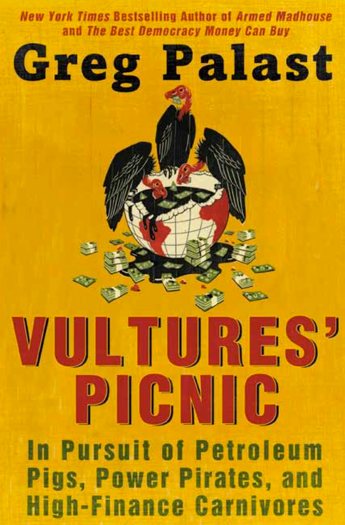 From Houston to New Orleans to Alaska to Liberia to Switzerland, Mr. Palast does as Woodward and Bernstein were told to do in All the President's Men - follow the money.
What follows is a tale of how transnational capital has decimated the lives of the poor across the planet. The oil companies polluted the people and the environment and the vultures of high finance have swooped in and forced foreign governments to kowtow to the will of their corporate overseers. The result of his investigation will open your eyes and make you think twice about what you think you know.
You'll recall that after the Exxon Valdez ran aground that folks cut up their Exxon credit cards, dipped them in oil and mailed them back. My wife refuses to go to an Exxon station to this day. But guess who was really at fault for the disaster in Prince William Sound. Not Exxon. BP - you know the company that portrays itself as green as a hemp-wearing tree hugger - was in charge of the terminal at Valdez. BP was in charge of ensuring that the clean up equipment was there. But guess what? There was no clean up equipment. But, for the good of the Seven Sisters, Exxon bent over and grabbed its ankles.
After the Transocean disaster in the Gulf, it was BP's turn to grin and bear it. But the boys in green weren't the ones making the decisions out there. All of the sisters were supposed to have a plan in place just in case a deep water well went to hell - and, as you know by now, there was no plan.
But what you probably didn't know is that the Transocean disaster wasn't BP's first rodeo. Out in the Caspian Sea, BP used a nitrogen-concrete blend to seal a well and, let's just say that didn't work out so well. But we're sold the line that what happened out in the Gulf was an accident. Once, my friends, is an accident. Twice is a pattern.
And, if you have trouble staying awake late at night, just read the section on the backup diesel generators at nuclear plants around the world. Here's a hint... Mother Nature wasn't to blame for the meltdown at Fukushima.
Friday, April 22, 2011
Earth Day 2011
Today is Earth Day.
This past Wednesday, on the other hand, marked the one year anniversary of BP/Deepwater Horizon blowout in the Gulf - one of the worst environmental disasters in history.
Friday, October 15, 2010
Looking beyond the headline
 On the surface, the Environmental Protection Agency's decision to allow higher concentrations (15%) of ethanol in gasoline sounds like a good move to halt the production of greenhouse gases. However, in reality, the costs of going forward will exceed the benefits.
The ethanol we mix with gasoline is a corn-based alcohol with a higher octane rating than conventional gasoline. The ethanol burns cleaner than the gasoline, reducing a car's exhaust emissions. However, the ethanol/gasoline blend you fill up with at the gas pump produces less energy than gasoline alone which means your fuel mileage will decrease. The 85/15 gasoline/ethanol blend will reduce fuel efficiency by approximately 25%.
The gasoline/ethanol blend costs the same as regular gasoline which means the cost of operating your car is higher due to the decreased fuel economy.
Then there's the cost, both economic and environmental, of producing ethanol. As ethanol is produced from corn, there is an increased demand for corn (and other feed grains), this, in turn, pushes feed prices higher which, in turn, pushes the price you pay for beef, pork or chicken higher. As more farmers try to squeeze higher yields from their cornfields, the demand for fertilizers increases. This pushes the cost of production higher. It also means that more petroleum products are used to produce fertilizer and that the amount of fertilizer run-off is increased. Since ethanol cannot be shipped through pipelines it has to be trucked to the refineries. Thus more diesel fuel is burned in transporting ethanol over the road - increasing the amount of diesel exhaust emissions.
Ethanol also costs far more to produce than an equivalent amount of gasoline. According to the US Department of Agriculture, the variable costs of producing a gallon of ethanol are $.96 while the capital costs are about $1.57 a gallon. So, while the average price for a gallon of gasoline in the US is $2.81, the average cost to produce a gallon of ethanol is $2.53! In order to make the product affordable, the federal government offers subsidies of between $1.05 and $1.38 a gallon.
Now I'm all for increasing fuel efficiency in cars and finding ways to reduce our use of natural resources, but increasing the amount of ethanol in gasoline is not the way to do it. This decision has less to do with conservation and more to do with income transfer and politics.
My point is not to accept at face value the story you're being told. Look behind the story. Look to the facts. Let the prosecutor tell his story -- then give the jury the opportunity to see behind the story. What didn't the prosecutor say? Why didn't he mention it? Let the jury come to its own conclusion.
Subscribe to:
Posts (Atom)