Now that the aerial search for the missing Malaysia Airlines jet has been called off, resources can now be turned toward finding the unmanned drone that crashed (under mysterious) circumstances in Lake Conroe. While the part of the Indian Ocean many believe the airliner crashed in is considered extremely remote, Lake Conroe has often been described as being on the very edge of civilization.
For some strange reason the Montgomery County Sheriff's Office made the decision - that was then ratified by county commissioners - to spend a quarter of a million dollars on an unmanned drone to provide aerial reconnaissance of SWAT team operations.
Dive teams have been unable to locate the remains of the drone due to conditions at the bottom of the lake.
Now why would a law enforcement agency in a suburban county need a $250,000 unmanned drone? Beyond the obvious reason that they could brag about having one, I can't think of any. While a spokesman for the Sheriff's Office said that the drone wasn't used for surveillance, I seem to recall the NSA claiming that Edward Snowden's claims were false. We all know how that turned out.
The use of unmanned drones by law enforcement is very troubling. The only reason a law enforcement agency would want a device capable of viewing the ground from up high is to find out what folks are doing on their property sheltered from the unauthorized view of law enforcement officers on the ground. With a camera-equipped drone flying overhead there is no such thing as privacy as the eye in the sky can see it all.
The use of drones, as well as the outfitting of police officers in military-style gear, is another move toward the militarization of the police. It is symbolic of the "us-against-them" mentality that seems to have taken hold in law enforcement over the past decade.
The incompetence of the folks operating the unmanned drone has cost Montgomery County taxpayers a lot of money - money that could have been used for parks or roads. Maybe those in charge of the county's purse strings will think twice about writing another check for another shiny toy.
Showing posts with label Montgomery County. Show all posts
Showing posts with label Montgomery County. Show all posts
Tuesday, April 29, 2014


Friday, March 7, 2014
Bending the law to satisfy the need for revenge
I would hope that we could all agree that the brain of a 13-year-old functions differently than the brain of a 28-year-old. I would hope that we could all agree that a 28-year-old has a better grasp on the consequences of actions than a 13-year-old has.
Fifteen years ago Robbie Middleton, who was eight years old, was tied to a tree, doused with gasoline and set on fire. He survived, horribly disfigured, but died in 2011 of cancer that a medical examiner said was caused by his burns. The case was refiled as a homicide.
Donald Collins, who was 13 at the time of the incident, was charged at the time but the case was later dismissed due to a lack of evidence. Shortly before his death, Robbie Middleton recorded a statement in which he claimed Mr. Collins sexually assaulted him a couple of weeks prior to the attack.
Prosecutors in Montgomery County moved to try Mr. Collins as an adult. The law at the time of the attack said that a defendant had to be at least 14 to be tried as an adult (which is in itself absurd). This week State District Judge Kathleen Hamilton ruled that Mr. Collins would be tried as an adult.
Of course we all know what the real argument was about. Forget about the law at the time regarding trying juveniles as adults. The problem was that if Mr. Collins were tried as a juvenile there would be little the court to do in the realm of punishment. The only way for the state to get its pound of flesh was to try Mr. Collins as an adult. So, despite the law, that's what happened.
The juvenile courts were set up with the understanding that kids are fundamentally different than adults and that we should be careful about the sanctions imposed on young people for their transgressions.The idea was to take the child away from the situation that got him into trouble and to rehabilitate him so that he didn't head back down that path as an adult.
Now let's just assume for a second that Mr. Collins is guilty of murder. The crime was heinous. The consequences for Robbie Middleton and his family were profound. But the fact remains that Mr. Collins was a teenager at the time of the attack. His brain wasn't fully developed. He didn't have a firm grasp on the consequences of his actions. Just think of yourself at 13 - did you do things back then that you wouldn't imagine doing today?
Trying Mr. Collins as a juvenile wouldn't satisfy the public's thirst for revenge. But that isn't the purpose of the criminal (in)justice system. At least it shouldn't be.
He may be an adult now, but he wasn't at the time of the attack. Trying him as a juvenile likely wouldn't lead to a very satisfying result, but it would lead to the right result. Sometimes the outcome can be right - even if we don't like it.
And sometimes we can jump through hoops to justify doing the wrong thing. That's just what Judge Hamilton did this week.
Fifteen years ago Robbie Middleton, who was eight years old, was tied to a tree, doused with gasoline and set on fire. He survived, horribly disfigured, but died in 2011 of cancer that a medical examiner said was caused by his burns. The case was refiled as a homicide.
Donald Collins, who was 13 at the time of the incident, was charged at the time but the case was later dismissed due to a lack of evidence. Shortly before his death, Robbie Middleton recorded a statement in which he claimed Mr. Collins sexually assaulted him a couple of weeks prior to the attack.
Prosecutors in Montgomery County moved to try Mr. Collins as an adult. The law at the time of the attack said that a defendant had to be at least 14 to be tried as an adult (which is in itself absurd). This week State District Judge Kathleen Hamilton ruled that Mr. Collins would be tried as an adult.
Of course we all know what the real argument was about. Forget about the law at the time regarding trying juveniles as adults. The problem was that if Mr. Collins were tried as a juvenile there would be little the court to do in the realm of punishment. The only way for the state to get its pound of flesh was to try Mr. Collins as an adult. So, despite the law, that's what happened.
The juvenile courts were set up with the understanding that kids are fundamentally different than adults and that we should be careful about the sanctions imposed on young people for their transgressions.The idea was to take the child away from the situation that got him into trouble and to rehabilitate him so that he didn't head back down that path as an adult.
Now let's just assume for a second that Mr. Collins is guilty of murder. The crime was heinous. The consequences for Robbie Middleton and his family were profound. But the fact remains that Mr. Collins was a teenager at the time of the attack. His brain wasn't fully developed. He didn't have a firm grasp on the consequences of his actions. Just think of yourself at 13 - did you do things back then that you wouldn't imagine doing today?
Trying Mr. Collins as a juvenile wouldn't satisfy the public's thirst for revenge. But that isn't the purpose of the criminal (in)justice system. At least it shouldn't be.
He may be an adult now, but he wasn't at the time of the attack. Trying him as a juvenile likely wouldn't lead to a very satisfying result, but it would lead to the right result. Sometimes the outcome can be right - even if we don't like it.
And sometimes we can jump through hoops to justify doing the wrong thing. That's just what Judge Hamilton did this week.
Wednesday, November 6, 2013
When driving the speed limit is breaking the law
If, on a highway having more than one lane with vehicles traveling in the same direction, the Texas Department of Transportation or a local authority places a sign that directs slower traffic to travel in a lane other than the farthest left lane, the sign must read "left lane for passing only." - Texas Transportation Code Sec. 544.011
An operator of a vehicle on a roadway moving more slowly than the normal speed of other vehicles at the time and place under the existing conditions shall drive in the right-hand lane available for vehicles, or as close as practicable to the right-hand curb or edge of the roadway, unless the operator is: (1) passing another vehicle; or (2) preparing for a left turn at an intersection or into a private road or driveway. -- Texas Transportation Code Sec. 545.051(b)
We all know that the left lane is the fast lane. We're all taught to pass to the left. I have been known to drive my car at a speed quite a bit above the one posted on the roadside traveling back and forth to the Dallas area for seminars - but even I move to the right when someone's coming up behind me at warp speed.
So, yes, there are plenty of motorists out there who think for some yet unknown reason that they are more than justified to plod along in the left lane at the speed limit. These tend to be the same people who count the number of items someone takes out of their basket in the express lane and who tattled on their younger siblings when they were growing up.
And, as much as I hate getting behind that person on the freeway, I have a hard time supporting anything that gives the police yet another excuse to pull someone over who isn't doing anything wrong. But, up in Montgomery County (the land the Constitution forgot) and out in Fort Bend County, if you're cruising along in the left lane not passing anyone - you risk getting pulled over and either being issued a warning or being ticketed. And, should you be coming home from a night out with friends after consuming an adult beverage or two, you could find yourself being arrested for driving while intoxicated.
Why else would Warren Diepraam and the Montgomery County District Attorney's Office get themselves involved in such an initiative? Hell, if you can't pull 'em over for doing anything illegal - you might as well pull them over for driving the speed limit.
So, as annoying as it may be to be driving behind the guy who thinks he needs to police speeds on the highway, the last thing we need to do is give the police yet another excuse to pull someone over. It's bad enough that we allow DWI stops based on behaviors that during the day wouldn't get a second glance from a police officer. But to allow a DWI stop when the only sin being committed is driving the speed limit in the wrong lane is hardly a good idea.
And what about officers who want to have it both ways? Are the police not going to ticket anyone for speeding if they are passing slower moving vehicles to the left? At the rate things are going, pretty soon up in Montgomery County driving on the highway alone will amount to reasonable suspicion that someone is breaking the law.
Thursday, January 31, 2013
Judge tells state to just test the damn DNA
Jeff Gamso has been fighting the good fight for longer than I'm sure he cares to remember. As a blogger, his work is "can't miss" reading. And his calls to just test the damn DNA are loud and clear.
On Wednesday in Montgomery County, of all places, a newly elected judge, Kelly Case, told the state to just test the damn DNA in Larry Swearingen's case. Mr. Swearingen was scheduled to be murdered by the state of Texas on February 27.
Now that proposed execution date has been pushed back to allow DNA testing on evidence found near the crime scene. A motion to test the evidence, based on a 2011 statute, was filed by Barry Scheck and The Innocence Project.
Judge Case has given both the state and Mr. Swearingen 60 days to file responses to Mr. Scheck's motion.
Ironically enough, it was Judge Case's predecessor, Fred Edwards, who denied Mr. Swearingen's motion for new trial late last year. Mr. Swearingen's attorneys had filed a motion for new trial based upon newly discovered evidence regarding decomposition science. Mr. Edwards ruled that decomposition science was a novel scientific theory and needed to be proven reliable in a pretrial hearing before he would consider it.
And that's where the irony comes in. As anyone who has tried a criminal case can attest, the general rule regarding scientific evidence in criminal trials is if it benefits the state, it's in; but, if it benefits the defense, it's out. Judges have had no problem allowing junk science into evidence when it's offered by the state - just take a look at the Cameron Willingham case.
Bite mark evidence, bullet composition evidence, tire mark evidence, "scent" lineups, psycho-babble about someone being a future danger to society. The list goes on. It's all been allowed in in the past because it helped the state obtain convictions. But, when the shoe is on the other foot and it's the state's ox that might get gored - then the judges slam on the brakes.
What happened in Conroe should be the rule, not the exception. If we're talking about taking the life of another person then we better be damn sure it's the right person. If there is DNA evidence that can be tested to determine if the person sentenced to die really did the crime - it should be tested. The stakes are too high to let the state play games. Either you got the right person, or you didn't.
I understand the fears of the state. We like to pretend that our criminal (in)justice system is fair and that it works. The truth, of course, is that it isn't and it doesn't. But to allow the public to look behind the curtain and see an innocent man released from death row shakes the public's confidence in our system to its core. And the fact that the process may have been fair but the result was a miscarriage of justice is cold comfort to those affected by an wrongful conviction and imprisonment.
On Wednesday in Montgomery County, of all places, a newly elected judge, Kelly Case, told the state to just test the damn DNA in Larry Swearingen's case. Mr. Swearingen was scheduled to be murdered by the state of Texas on February 27.
Now that proposed execution date has been pushed back to allow DNA testing on evidence found near the crime scene. A motion to test the evidence, based on a 2011 statute, was filed by Barry Scheck and The Innocence Project.
Judge Case has given both the state and Mr. Swearingen 60 days to file responses to Mr. Scheck's motion.
Ironically enough, it was Judge Case's predecessor, Fred Edwards, who denied Mr. Swearingen's motion for new trial late last year. Mr. Swearingen's attorneys had filed a motion for new trial based upon newly discovered evidence regarding decomposition science. Mr. Edwards ruled that decomposition science was a novel scientific theory and needed to be proven reliable in a pretrial hearing before he would consider it.
And that's where the irony comes in. As anyone who has tried a criminal case can attest, the general rule regarding scientific evidence in criminal trials is if it benefits the state, it's in; but, if it benefits the defense, it's out. Judges have had no problem allowing junk science into evidence when it's offered by the state - just take a look at the Cameron Willingham case.
Bite mark evidence, bullet composition evidence, tire mark evidence, "scent" lineups, psycho-babble about someone being a future danger to society. The list goes on. It's all been allowed in in the past because it helped the state obtain convictions. But, when the shoe is on the other foot and it's the state's ox that might get gored - then the judges slam on the brakes.
What happened in Conroe should be the rule, not the exception. If we're talking about taking the life of another person then we better be damn sure it's the right person. If there is DNA evidence that can be tested to determine if the person sentenced to die really did the crime - it should be tested. The stakes are too high to let the state play games. Either you got the right person, or you didn't.
I understand the fears of the state. We like to pretend that our criminal (in)justice system is fair and that it works. The truth, of course, is that it isn't and it doesn't. But to allow the public to look behind the curtain and see an innocent man released from death row shakes the public's confidence in our system to its core. And the fact that the process may have been fair but the result was a miscarriage of justice is cold comfort to those affected by an wrongful conviction and imprisonment.
Friday, May 25, 2012
Brother, can you spare a bill or two?
I received a mailer a few days ago - well, actually a few weeks ago - from a sitting family court judge who was holding a fundraiser not too far from my office. Why, you might ask, is this newsworthy? That is a good question.
I live and work (for the most part) in Houston which is in Harris County. The judge in question sits on a bench in Montgomery County (hop on the freeway and head north). Now why would a judge in Montgomery County hold a fundraiser in another county? That question kept coming up in my mind.
None of the attorneys (probably a safe assumption that the recipients of the mailer were attorneys) lived in Montgomery County. None of the attorneys are eligible to vote in Montgomery County. But I would say it's a good bet that each of the attorneys has handled at least one case in that judge's court.
Which raises the question of why an attorney in one county would be persuaded to write a check to the campaign of a judge in another county. Could it possibly be the perception that the judge would look more kindly upon those attorneys who "made it rain?"
And what might give someone that impression? Surely judges don't give preferential treatment to attorneys who line their pockets during campaign season. Surely no attorney would give a campaign contribution to a judge in the hopes that it might curry him some favor down the road.
But why else would a Houston attorney give money to a Montgomery County family court judge who's also a deadbeat dad?
Our method of picking judges here in Texas is certainly flawed. There is something just a bit unseemly about attorneys making campaign contributions to judge in whose courtrooms they practice. There's something very unsettling about watching judicial candidates portray themselves as being tougher on crime (whatever that means) and more conservative than the person sitting next to them. It's just plain asinine for entire slates of judges to be elected (or tossed out) because they have an R or a D after their name.
Of course, electing them is the least worst alternative.
I live and work (for the most part) in Houston which is in Harris County. The judge in question sits on a bench in Montgomery County (hop on the freeway and head north). Now why would a judge in Montgomery County hold a fundraiser in another county? That question kept coming up in my mind.
None of the attorneys (probably a safe assumption that the recipients of the mailer were attorneys) lived in Montgomery County. None of the attorneys are eligible to vote in Montgomery County. But I would say it's a good bet that each of the attorneys has handled at least one case in that judge's court.
Which raises the question of why an attorney in one county would be persuaded to write a check to the campaign of a judge in another county. Could it possibly be the perception that the judge would look more kindly upon those attorneys who "made it rain?"
And what might give someone that impression? Surely judges don't give preferential treatment to attorneys who line their pockets during campaign season. Surely no attorney would give a campaign contribution to a judge in the hopes that it might curry him some favor down the road.
But why else would a Houston attorney give money to a Montgomery County family court judge who's also a deadbeat dad?
Our method of picking judges here in Texas is certainly flawed. There is something just a bit unseemly about attorneys making campaign contributions to judge in whose courtrooms they practice. There's something very unsettling about watching judicial candidates portray themselves as being tougher on crime (whatever that means) and more conservative than the person sitting next to them. It's just plain asinine for entire slates of judges to be elected (or tossed out) because they have an R or a D after their name.
Of course, electing them is the least worst alternative.
Wednesday, April 18, 2012
Unarmed, paralyzed and dead
Bryan Keith Carnes supposedly ran a red light in the early morning hours of Tuesday, April 17, 2012 in Willis, Texas. For those of y'all not familiar with the geography of the Houston area, Willis is about 40 miles north of Houston on Interstate 45.
For reasons we shall never know, Mr. Carnes decided not to stop. He continued driving south on I-45 toward Houston. As he approached The Woodlands (about 25 miles north of Houston), the camper on Mr. Carnes' truck raised and a wheelchair was hoisted on a boom and allowed to bounce on the freeway. Somewhere near Woodlands Parkway a spike strip was laid out. As soon as Mr. Carnes' truck hit the strip the tires blew out and he crashed into the barricade.
Mr. Carnes was then shot to death by a Montgomery County Sheriff's Deputy who fired three shots into the truck. The yet-unnamed officer claimed that Mr. Carnes told police to shoot him and that he reached under his seat as officers approached the truck.
Mr. Carnes was a father and a paraplegic. The wheelchair in the bed of the truck was his.
I'm sure the deputy who killed Mr. Carnes will claim that he thought Mr. Carnes was reaching for a weapon. But, strangely enough, the article makes no mention of whether any weapon was found in the truck. As there were no witnesses around, save law enforcement officers, we have no independent source to verify that Mr. Carnes told the officers to shoot him.
Mr. Carnes wasn't going anywhere. His truck couldn't be driven. He couldn't access his wheelchair. There was no need to shoot him. We know there wasn't a weapon (because you know damn well that if there were the police would have made one freaking big deal about it).
We don't know how fast Mr. Carnes was driving - but the police officers involved made no claim that it was a high speed chase (and, once again, you know damn well that if it had been a high speed chase the police would have made one freaking bid deal about it).
There was no need for the police to shoot and kill Bryan Carnes. But what you had were a bunch of armed officers with adrenaline coursing through their bodies. And the result is a dead father and a grieving family. Now where's the justice in that?
For reasons we shall never know, Mr. Carnes decided not to stop. He continued driving south on I-45 toward Houston. As he approached The Woodlands (about 25 miles north of Houston), the camper on Mr. Carnes' truck raised and a wheelchair was hoisted on a boom and allowed to bounce on the freeway. Somewhere near Woodlands Parkway a spike strip was laid out. As soon as Mr. Carnes' truck hit the strip the tires blew out and he crashed into the barricade.
Mr. Carnes was then shot to death by a Montgomery County Sheriff's Deputy who fired three shots into the truck. The yet-unnamed officer claimed that Mr. Carnes told police to shoot him and that he reached under his seat as officers approached the truck.
Mr. Carnes was a father and a paraplegic. The wheelchair in the bed of the truck was his.
I'm sure the deputy who killed Mr. Carnes will claim that he thought Mr. Carnes was reaching for a weapon. But, strangely enough, the article makes no mention of whether any weapon was found in the truck. As there were no witnesses around, save law enforcement officers, we have no independent source to verify that Mr. Carnes told the officers to shoot him.
Mr. Carnes wasn't going anywhere. His truck couldn't be driven. He couldn't access his wheelchair. There was no need to shoot him. We know there wasn't a weapon (because you know damn well that if there were the police would have made one freaking big deal about it).
We don't know how fast Mr. Carnes was driving - but the police officers involved made no claim that it was a high speed chase (and, once again, you know damn well that if it had been a high speed chase the police would have made one freaking bid deal about it).
There was no need for the police to shoot and kill Bryan Carnes. But what you had were a bunch of armed officers with adrenaline coursing through their bodies. And the result is a dead father and a grieving family. Now where's the justice in that?
Saturday, February 25, 2012
Speedtrapped
For anyone who has spent any time traveling on US59 north of Houston, the name "Patton Village" evokes strong emotions. For those of y'all not familiar with the area, Patton Village is one of the most (in)famous speedtraps in this part of the state.
But for the city limits sign on the highway, you'd never know it was there. I have no idea what's in Patton Village - but I do know the local police patrol a stretch of 59 as if the future security of the Republic depended upon it.
Now it would seem that the worm has turned, so to speak.
Yesterday the mayor of Patton Village was arrested and six other city officials, including the court clerk and three police officers, were indicted in Montgomery County following an investigation by the Montgomery County District Attorney's Office, the Texas Rangers, DEA, FBI, DPS and the Department of Agriculture(?).
The charges include abuse of official capacity, misuse of official information, misapplication of fiduciary property, securing execution of a document by deception and theft by public servant.
Yes, I know those folks are innocent unless proven guilty - but it's more than a bit hard to have any sympathy for people who have abused power to the degree they did up there.
Here's your salute to the political establishment of Patton Village, courtesy of Sammy Hagar...
But for the city limits sign on the highway, you'd never know it was there. I have no idea what's in Patton Village - but I do know the local police patrol a stretch of 59 as if the future security of the Republic depended upon it.
Now it would seem that the worm has turned, so to speak.
Yesterday the mayor of Patton Village was arrested and six other city officials, including the court clerk and three police officers, were indicted in Montgomery County following an investigation by the Montgomery County District Attorney's Office, the Texas Rangers, DEA, FBI, DPS and the Department of Agriculture(?).
The charges include abuse of official capacity, misuse of official information, misapplication of fiduciary property, securing execution of a document by deception and theft by public servant.
Yes, I know those folks are innocent unless proven guilty - but it's more than a bit hard to have any sympathy for people who have abused power to the degree they did up there.
Here's your salute to the political establishment of Patton Village, courtesy of Sammy Hagar...
Friday, January 13, 2012
Crime lab loses federal funding
The honeymoon for Sam Houston State's Regional Crime Lab in The Woodlands is now over.
The lab was opened with the help of a federal grant and the understanding that the lab would become self-sufficient after three years. Owing to the iron law of budgeting (he who holds the iron makes the budget), that three year window ended about two years early.
The lab had charged Montgomery County, its largest customer, $200 for every drug or alcohol test in DWI cases. Without the funding from the feds, MoCo will pay $386 for alcohol tests and $290 for drug tests. Due to the increasing costs of operating the lab, all controlled substance evidence tests will be handled by the DPS. The switch will increase the wait time for test results.
But how to pay for the increased cost of testing is the question. The original idea was that MoCo would pay for the tests through sentencing fees for those who plead guilty or are convicted at trial. But that only covered about 3% of the cost. MoCo District Attorney Bret Ligon now wants to use the asset forfeiture fund to pay for the tests.
The problem, of course, is the increased incentive to seize property and file forfeiture actions against defendants. Forfeiture actions serve to tie up defendant's assets and make it that much harder to muster a defense against the state. You will also find out that the vast majority of defendants either default or negotiate settlements in which they receive just a portion of the value of the items seized. The asset forfeiture funds then become a private slush fund for whoever's running the DA's Office (just ask former MoCo DA Michael McDougal). Of course there's no telling where the property seized in Tenaha went.
In the meantime, however, defendants in MoCo will have to wait longer for lab results to come back in drug cases as it can take up to nine months for the DPS lab to release test results. In the meantime that's nine months of missing work to take yourself to court (if you're on bond) or (if you can't make bond) the prospect of sitting in a cell for nine months waiting to fight a case.
Some of the lessons from MoCo's crime lab are obvious. First, for entities involved in the criminal (in)justice system who rely upon government funds to operate - those funds will diminish or vanish at some point, even if the entity is there to help the state. Second, the lab should have charged a more realistic rate for their services; the excess would allow for a "cushion" when the funding was cut or dropped. Third, no one gives a rat's ass about the people accused of committing a crime.
The lab was opened with the help of a federal grant and the understanding that the lab would become self-sufficient after three years. Owing to the iron law of budgeting (he who holds the iron makes the budget), that three year window ended about two years early.
The lab had charged Montgomery County, its largest customer, $200 for every drug or alcohol test in DWI cases. Without the funding from the feds, MoCo will pay $386 for alcohol tests and $290 for drug tests. Due to the increasing costs of operating the lab, all controlled substance evidence tests will be handled by the DPS. The switch will increase the wait time for test results.
But how to pay for the increased cost of testing is the question. The original idea was that MoCo would pay for the tests through sentencing fees for those who plead guilty or are convicted at trial. But that only covered about 3% of the cost. MoCo District Attorney Bret Ligon now wants to use the asset forfeiture fund to pay for the tests.
The problem, of course, is the increased incentive to seize property and file forfeiture actions against defendants. Forfeiture actions serve to tie up defendant's assets and make it that much harder to muster a defense against the state. You will also find out that the vast majority of defendants either default or negotiate settlements in which they receive just a portion of the value of the items seized. The asset forfeiture funds then become a private slush fund for whoever's running the DA's Office (just ask former MoCo DA Michael McDougal). Of course there's no telling where the property seized in Tenaha went.
In the meantime, however, defendants in MoCo will have to wait longer for lab results to come back in drug cases as it can take up to nine months for the DPS lab to release test results. In the meantime that's nine months of missing work to take yourself to court (if you're on bond) or (if you can't make bond) the prospect of sitting in a cell for nine months waiting to fight a case.
Some of the lessons from MoCo's crime lab are obvious. First, for entities involved in the criminal (in)justice system who rely upon government funds to operate - those funds will diminish or vanish at some point, even if the entity is there to help the state. Second, the lab should have charged a more realistic rate for their services; the excess would allow for a "cushion" when the funding was cut or dropped. Third, no one gives a rat's ass about the people accused of committing a crime.
Tuesday, November 1, 2011
Eyes in the sky
Unmanned drones will soon be making their appearance in the skies over Montgomery County, Texas. Officials with the Montgomery County Sheriff's Office are excited about the latest addition to their arsenal of tools to violate the people's right to be left alone.
Supposedly the drones will be used to "hunt criminals" and find missing persons.
But the drones will be flying over private property while conducting these searches. Well, what's the problem with that, you ask. The problem is the irreparable harm these flights will do to the citizenry's reasonable expectation of privacy.
You see, our rights to be protected against unlawful search and seizure are based on this vague notion of whether a particular intrusion violates a person's reasonable expectation of privacy. Right now a homeowner would have a reasonable expectation that no one is snooping on him in his own backyard if he has a fence or trees of shrubs that shield the public's view of his yard. But, announce that you will be sending unmanned drones on missions throughout the county and one's expectation that he will be left alone in his backyard goes out the window.
Of course the authors of the Bill of Rights had no idea that one day man would be able to soar through the skies in motorized flying machines. That just made it easier for the government to declare that your personal space did not extend upward into the heavens.
It's much like the situation at the nation's airports these days. The government tells you that you will have little or no expectation of privacy in an airport terminal if you expect to board a plane - that means you have no reasonable expectation of privacy. That means the government doesn't need a warrant to conduct a search of you or your bags.
The apparent goal of the state is to place as much of the public under their eyes (and thumbs) as possible. Quite ironic in this era in which every politician on the right screams to the high heavens of his fervent belief in limited government. The feudal lords north of Houston can proclaim all they want that these drones will make the public safer, but I'm not buying it.
Quite the contrary, the forces of the state are consolidating their power over the people. We have someone forgotten the words Abraham Lincoln spoke on the hallowed battleground of Gettysburg. The government is here to serve us, not the other way around.
In the name of protecting ourselves from whatever the threat of the month may be, we have allowed our interests to be made subservient to those of the government, including our right to be left alone. Someone please explain to me how that embodies the ideal of limited government.
See also:
"Droning on in Montgomery County: unmanned aircraft could be mounted with weapons," Grits for Breakfast (Oct. 29, 2011)
"Texas civil libertarians have an eye on police drones," Houston Chronicle (Oct. 31, 2011)
Supposedly the drones will be used to "hunt criminals" and find missing persons.
But the drones will be flying over private property while conducting these searches. Well, what's the problem with that, you ask. The problem is the irreparable harm these flights will do to the citizenry's reasonable expectation of privacy.
You see, our rights to be protected against unlawful search and seizure are based on this vague notion of whether a particular intrusion violates a person's reasonable expectation of privacy. Right now a homeowner would have a reasonable expectation that no one is snooping on him in his own backyard if he has a fence or trees of shrubs that shield the public's view of his yard. But, announce that you will be sending unmanned drones on missions throughout the county and one's expectation that he will be left alone in his backyard goes out the window.
Of course the authors of the Bill of Rights had no idea that one day man would be able to soar through the skies in motorized flying machines. That just made it easier for the government to declare that your personal space did not extend upward into the heavens.
It's much like the situation at the nation's airports these days. The government tells you that you will have little or no expectation of privacy in an airport terminal if you expect to board a plane - that means you have no reasonable expectation of privacy. That means the government doesn't need a warrant to conduct a search of you or your bags.
The apparent goal of the state is to place as much of the public under their eyes (and thumbs) as possible. Quite ironic in this era in which every politician on the right screams to the high heavens of his fervent belief in limited government. The feudal lords north of Houston can proclaim all they want that these drones will make the public safer, but I'm not buying it.
Quite the contrary, the forces of the state are consolidating their power over the people. We have someone forgotten the words Abraham Lincoln spoke on the hallowed battleground of Gettysburg. The government is here to serve us, not the other way around.
In the name of protecting ourselves from whatever the threat of the month may be, we have allowed our interests to be made subservient to those of the government, including our right to be left alone. Someone please explain to me how that embodies the ideal of limited government.
See also:
"Droning on in Montgomery County: unmanned aircraft could be mounted with weapons," Grits for Breakfast (Oct. 29, 2011)
"Texas civil libertarians have an eye on police drones," Houston Chronicle (Oct. 31, 2011)
Tuesday, October 11, 2011
Search warrants for dummies
Maybe it's because they're lazy. Maybe it's because they can't be trusted to do it right by themselves. Whatever the reason for it, this is blood search warrants for dummies:
MoCo Search Warrant
There's no such thing as a fill-in-the-blank and check-the-boxes search warrant affidavit for any other criminal offense. Judges reviewing warrants to search a house in a felony case take more time to review the affidavit for probable cause than do judges deciding whether or not to allow the state to jab a needle in a motorist's arm.
This is your government at work - against you and your rights.
MoCo Search Warrant
There's no such thing as a fill-in-the-blank and check-the-boxes search warrant affidavit for any other criminal offense. Judges reviewing warrants to search a house in a felony case take more time to review the affidavit for probable cause than do judges deciding whether or not to allow the state to jab a needle in a motorist's arm.
This is your government at work - against you and your rights.
Friday, July 22, 2011
Splitting hairs and denying relief
In 1999, Neal Hampton Robbins was convicted of capital murder in the death of his girlfriend's 17-month-old child. In 2011, the Texas Court of Criminal Appeals denied his request for relief due as a result of "false or misleading testimony."
During the investigation into the death of the child, Dr. Patricia Moore of the Harris County Medical Examiner's Office was asked to conduct an autopsy. She concluded in her report that the child died due to "asphyxia of the chest and abdomen" and that the child was the victim of a homicide. At trial, the defense expert, Dr. Robert Bux of the Bexar County Medical Examiner's Office testified that the cause and manner of death could not be determined.
In 2007, Dr. Dwayne Wolf of the HCMEO was asked to review Dr. Moore's findings in the case. In May of that year, Dr. Wolf amended the death certificate to indicate that the cause and manner of death could not be determined. Dr. Moore's supervisor at the time of the autopsy, Dr. Joye Carter, told Montgomery County prosecutors that she concurred with Dr. Wolf's findings.
Then Dr. Moore sent a letter to the Montgomery County DA's Office and stated:
In June 2007, Mr. Robbins filed a writ of habeas corpus asking that his conviction be vacated as the result of newly discovered evidence. The State of Texas, in its initial response, concurred. The trial court, however, appointed another forensic pathologist to review the documents in the case. Dr. Thomas Wheeler of the Baylor College of Medicine also concluded that the cause and manner of death could not be determined.
A Montgomery County Justice of the Peace then appointed another forensic pathologist to review the case. This time the state got what it wanted - Linda Norton concluded that the child was suffocated. She said she believed the child was murdered but could not state beyond a reasonable doubt that Mr. Robbins killed the child.
In August 2008, both Mr. Robbins and the state prepared findings of fact and conclusions of law stating that Mr. Robbins was entitled to a new trial. However, after Ms. Norton reaffirmed her opinion that the child was murdered, the state changed its tune and urged the court not to grant any relief to Mr. Robbins.
In January 2010, the trial court denied relief for Mr. Robbins stating that the changed opinion of an expert witness was not sufficient to overturn a jury's decision to convict.
Last month the Texas Court of Criminal Appeals ruled that since Dr. Moore's trial testimony hadn't been proven false, that Mr. Robbin's claim of actual innocence failed. The majority found that Dr. Moore's changed opinion did not render her trial testimony false. The court relied on the fact that Dr. Moore testified "openly" about her findings and conclusions.
The court's rationale was that no one testified that Mr. Robbins didn't commit the murder.
I think we owe it to Mr. Robbins to find out.
During the investigation into the death of the child, Dr. Patricia Moore of the Harris County Medical Examiner's Office was asked to conduct an autopsy. She concluded in her report that the child died due to "asphyxia of the chest and abdomen" and that the child was the victim of a homicide. At trial, the defense expert, Dr. Robert Bux of the Bexar County Medical Examiner's Office testified that the cause and manner of death could not be determined.
In 2007, Dr. Dwayne Wolf of the HCMEO was asked to review Dr. Moore's findings in the case. In May of that year, Dr. Wolf amended the death certificate to indicate that the cause and manner of death could not be determined. Dr. Moore's supervisor at the time of the autopsy, Dr. Joye Carter, told Montgomery County prosecutors that she concurred with Dr. Wolf's findings.
Then Dr. Moore sent a letter to the Montgomery County DA's Office and stated:
I believe that there are unanswered questions as to why the child died, and I still feel that this is a suspicious death of a young child. Given my review of all the material from the case file and having had more experience in the field of forensic pathology, I now feel that an opinion for a cause and manner of death of undetermined, undetermined is best for this case.Dr. Moore went on to state that since the date of the autopsy she had received additional training and believed that the bruises on the child's body could have been caused by aggressive CPR or other attempts to revive the child.
In June 2007, Mr. Robbins filed a writ of habeas corpus asking that his conviction be vacated as the result of newly discovered evidence. The State of Texas, in its initial response, concurred. The trial court, however, appointed another forensic pathologist to review the documents in the case. Dr. Thomas Wheeler of the Baylor College of Medicine also concluded that the cause and manner of death could not be determined.
A Montgomery County Justice of the Peace then appointed another forensic pathologist to review the case. This time the state got what it wanted - Linda Norton concluded that the child was suffocated. She said she believed the child was murdered but could not state beyond a reasonable doubt that Mr. Robbins killed the child.
In August 2008, both Mr. Robbins and the state prepared findings of fact and conclusions of law stating that Mr. Robbins was entitled to a new trial. However, after Ms. Norton reaffirmed her opinion that the child was murdered, the state changed its tune and urged the court not to grant any relief to Mr. Robbins.
In January 2010, the trial court denied relief for Mr. Robbins stating that the changed opinion of an expert witness was not sufficient to overturn a jury's decision to convict.
Last month the Texas Court of Criminal Appeals ruled that since Dr. Moore's trial testimony hadn't been proven false, that Mr. Robbin's claim of actual innocence failed. The majority found that Dr. Moore's changed opinion did not render her trial testimony false. The court relied on the fact that Dr. Moore testified "openly" about her findings and conclusions.
The court's rationale was that no one testified that Mr. Robbins didn't commit the murder.
Here, similar to the criminalist's testimony that she could not positively identify the sample, cross-examination by the Applicant established that Moore's testimony was her professional opinion and that she was not ruling out other reasonable hypothesis by which Tristen died. In addition, like the criminalist's testimony, that asphyxia was the cause and homicide the manner of Tristen's death has not been entirely refuted. As the convicting court determined, "[n]o expert rules out asphyxia as the cause of death," "[n]o expert can exclude Applicant as the perpetrator if it is a homicide, and no expert has excluded homicide as the manner of death." During the habeas proceedings, various experts have opined that the autopsy findings do not adequately support Moore's conclusion that the death was a homicide by asphyxiation (and Moore herself has adopted that position, but none of the experts have stated that Tristen could not have been intentionally asphyxiated. And although they critique Moore's interpretation of the petechiae evidence upon which she relied at trial, the "non-specific" indicator cannot be ruled out as being the result of asphyxiation. On the other hand, at least one well-qualified pathologist, Dr. Norton, has concluded that the child was a victim of homicide by asphyxiation.In dissent, Judge Alcala (the newest member of the panel) argued that the majority was splitting hairs and denying Mr. Robbins the relief to which he was entitled. She wrote:
The record shows that, as the sole witness establishing cause and manner of death for the State at Robbins's trial, Dr. Moore testified that, based on her scientific opinion beyond a reasonable doubt, the cause of Tristen Rivet's death was asphyxia due to compression of the chest and abdomen, and the manner of death was homicide. In her evidence concerning this application for a writ of habeas corpus, she now concludes that the cause of death was, beyond a reasonable doubt, not compression asphyxia, and undeterminable as to homicide, asphyxial or otherwise. Dr. Moore's subsequent testimony is a complete refutation of her trial testimony because, although her trial testimony stated that, beyond a reasonable doubt, the cause of death was compression asphyxia and the manner of death was homicide, she now says that the cause and manner of death are, beyond a reasonable doubt, "undeterminable." Both positions cannot be true. This wholesale refutation of her previously professed scientific certainty nullifies the veracity of the conclusion itself...
Perhaps Dr. Moore's testimony could not be called "false" if, for example, she consistently determined, beyond a reasonable doubt, that the manner and cause of death could be established with scientific certainty and that the manner of death was homicide, but was uncertain whether the cause of death was asphyxia by some means other than compression. See Berger v. United States, 295 U.S. 78, 82 (1935) ("The true inquiry, therefore, is not whether there has been a variance in proof, but whether there has been such a variance as to 'affect the substantial rights' of the accused."). But Dr. Moore's changed testimony is not merely a variance in proof. Her present position acknowledges that the cause and manner of death could possibly be natural causes or homicide and that both are equally likely. An acknowledgment that trial testimony could possibly be correct because no one can determine the cause and manner of death with scientific certainty is vastly different from evidence that the cause and manner of death are proven beyond a reasonable doubt with scientific certainty. I, therefore, agree with the trial court's assessment that the record shows that Dr. Moore's testimony was false.Mr. Robbins should receive a new trial. While Dr. Moore didn't lie on the stand during Mr. Robbins' trial, she has re-evaluated her findings and she has come to a new conclusion. That new conclusion contradicts the testimony she gave at trial. Had the jury heard this new testimony, the question becomes was there a murder?
I think we owe it to Mr. Robbins to find out.
Monday, July 11, 2011
Sign of the times

"Fourth Amendment? What's that? We don't need no stinkin' probable cause up here in Conroe!"
If a search warrant for blood is "mandatory" up in Montgomery County, does probable cause even exist up there? If judges are willing to rubber stamp fill-in-the-blank and check-the-boxes search warrant applications, is there no such thing as an unreasonable search or seizure? If you're telling the driving public that you're going to take their blood if they refuse a breath test, isn't that coercion - and doesn't that make "consent" invalid?
Is any judge in Montgomery County willing to stand up to Brett Ligon and his minions and suppress breath or blood results that were obtained through coercive means? Is any judge in Montgomery County willing to stand up to Brett Ligon and his minions and scrutinize these fill-in-the-blank and check-the-boxes warrant applications?
Monday, April 11, 2011
Not a good week to be on trial in Montgomery County
By proclamation of our dear leader, the fair-haired one, Governor Rick Perry, the week of April 10-16, 2011 is "The Defendant's Not Deserving of a Fair Trial Week."
 We all have the right to be free from unreasonable search and seizure at the hand of the state. Those accused of breaking the law have the right to remain silent and the right to consult with an attorney. Defendants at trial have the right to trial by jury and due process rights, including the right of confrontation.
The state has the right to notice of certain items as well as the right to demand a trial by jury.
The complaining witness (the alleged victim) has no rights in criminal court. The complaining witness is not a party to the litigation.This notion that "victims" have rights assumes that a crime was committed and is used as a front for attacking the Bill of Rights and a criminal defendant's due process rights.
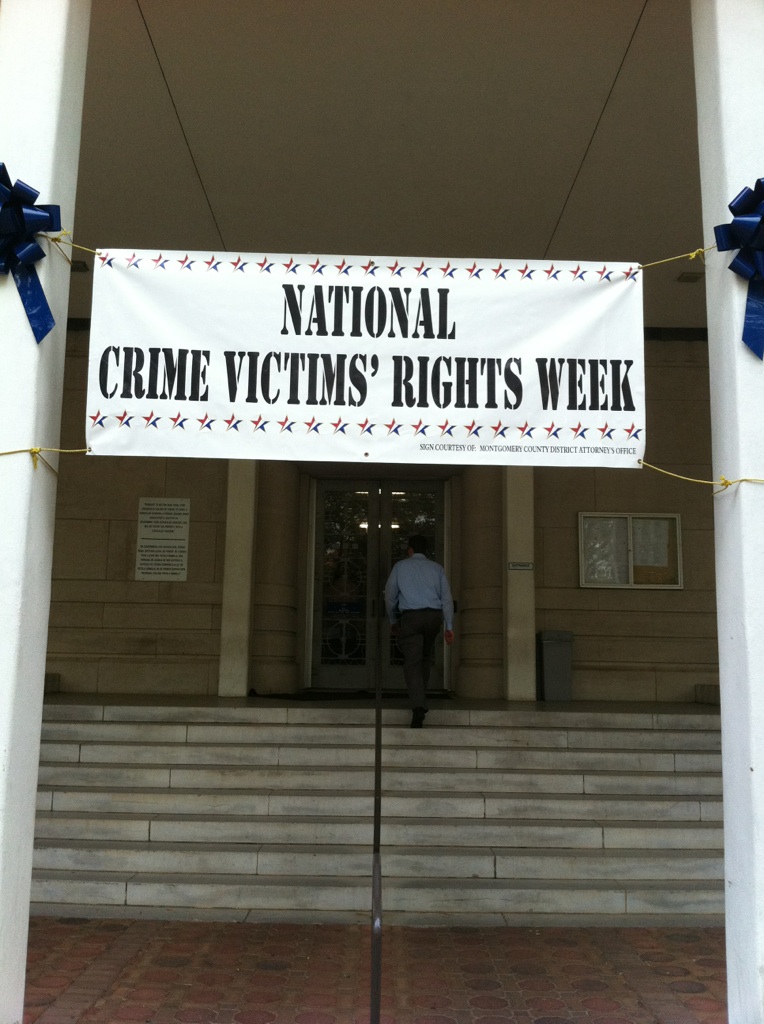
Up in Montgomery County they take that notion to an extreme with a banner across the courthouse entrance and a "Crime Victim Memorial Wall" in the courthouse. Nothing like walking a jury passed those displays and then expecting them to sit in judgment of another without being influenced by it.
When a person sits at the defense table facing a jury of his peers, he deserves a jury that is going to make its decision solely on the facts of his case, not a jury that's going to base its decision on the fact that someone thinks a message must be sent or that a statement must be made.
Now I'm sure there are plenty of folks who don't see the problem with these proclamations and displays - and I understand that attitude. After all, most of us will never set foot in a courtroom accused by the state of committing a criminal act. But in the event that someone you know finds himself or herself in that position, would you want a jury who would presume them innocent unless proven guilty or a jury that was exposed to pro-prosecution propaganda on the way into the courthouse?
That's the real issue here.
The state has the right to notice of certain items as well as the right to demand a trial by jury.
The complaining witness (the alleged victim) has no rights in criminal court. The complaining witness is not a party to the litigation.This notion that "victims" have rights assumes that a crime was committed and is used as a front for attacking the Bill of Rights and a criminal defendant's due process rights.
Up in Montgomery County they take that notion to an extreme with a banner across the courthouse entrance and a "Crime Victim Memorial Wall" in the courthouse. Nothing like walking a jury passed those displays and then expecting them to sit in judgment of another without being influenced by it.
When a person sits at the defense table facing a jury of his peers, he deserves a jury that is going to make its decision solely on the facts of his case, not a jury that's going to base its decision on the fact that someone thinks a message must be sent or that a statement must be made.
Now I'm sure there are plenty of folks who don't see the problem with these proclamations and displays - and I understand that attitude. After all, most of us will never set foot in a courtroom accused by the state of committing a criminal act. But in the event that someone you know finds himself or herself in that position, would you want a jury who would presume them innocent unless proven guilty or a jury that was exposed to pro-prosecution propaganda on the way into the courthouse?
That's the real issue here.
Monday, December 13, 2010
Greetings from Montgomery County

Highway sign welcoming you to Montgomery County, Texas -- otherwise known as the land the Constitution forgot.
Tuesday, November 23, 2010
Floggings at noon

A crowd of folks who play Dungeons & Dragons and World of Warcraft and walk around talking in lousy British accents would seem fairly harmless provided I'm not forced to attend; but the local constabulary has decided that the festival's attendees make the roads in and around the hamlet a bit too hazardous for the local folk.
To catch the drunken drivers, the number of patrol officers on this task will increase from 20 to 30. Roads with extra patrols will include Texas 249, Texas 105, FM 1774, FM 1488 and FM 1486.
"We will not have random security checkpoints for vehicles," Diepraam said. "but we will be stopping anyone who violates traffic laws."
Two BAT (Breath, Alcohol and Transport) vans from Houston and Montgomery County will be available to offer Breathalyzer tests on the spot. If the driver refuses, authorities will seek a search warrant and then transport the driver to Magnolia's police station where a nurse will be on standby to do a blood test.
And so, much as was the case with the Salem witch trials, the motorist who is pulled over for a random traffic violation will be subjected to trial by deed with the officer's unscientific opinion being the linchpin upon which his constitutional rights rest.
Thursday, October 28, 2010
Montgomery County to disregard the Constitution this weekend
If you find yourself cruising along the highways and by-ways of Montgomery County this weekend, be careful because it's a "Shred the Constitution" Weekend according to this tweet from Brett Ligon, Montgomery County District Attorney.
Don't say you haven't been warned.
MontgomeryTXDAO: Conroe Police Dept, TABC, MC Sheriff's Office, DPS and others will be out in force working No Refusal this weekend.That Fourth Amendment right to be free from unreasonable search and seizure? Get real. That ain't worth the paper it's printed on when there's money to be made from reinstatement fees, surcharges, bonds, court costs and probation fees.
Don't say you haven't been warned.
Monday, October 18, 2010
Mama said knock you out
 Montgomery County DA Brett Ligon is on the warpath against State District Judge Cara Wood because he thinks the judge handed out a light sentence to a man who plead guilty to aggravated robbery, aggravated assault and evading charges.
The sentence of which Mr. Ligon complains? Twenty years for the assault, 15 years on the robbery and two years on the evading charge. Under the parole rules drawn up by the Texas Department of Criminal Justice, the defendant will be eligible for parole in about 9 1/2 years.
When a jury is asked to sentence a defendant who has been convicted, the jury is not told how much time a person is likely to do based on parole guidelines. In fact, it is none of the jury's concern. The fact that Judge Wood has a good idea how much time one is likely to do in prison likewise shouldn't play any role in her determination of what sentence to mete out. If Mr. Ligon is unhappy, take it up with the parole board or TDCJ.
The defendant in this case plead to the court without a recommendation. Why would an attorney advise his client to plead guilty in a case without knowing what the sentence would be? Most likely because he had reason to believe that the judge was going to hand down a lighter sentence than the prosecutor was offering. Maybe Mr. Ligon needs to take a look in the mirror if he needs someone to blame.
Sunday, September 12, 2010
The passing of a hero
About 30 years ago in Conroe a manager for the Bellville High School volleyball team was raped and killed in a bathroom at Conroe High School during a pre-season volleyball tournament. Police arrested Clarence Brandley, a black janitor, for the crime. I grew up in Conroe and while I don't remember all of the details (I was getting ready to start my 8th grade year at Travis Jr. High), I do remember the mood.
It was the classic southern crime story -- a black male accused of raping and killing a white girl. Mr. Brandley was portrayed as a monster and a predator while the victim, Cheryl Ferguson, was beatified. While there was some physical evidence, little of it was ever tested and, later, what there was turned up missing. I remember writing a letter to the editor of the Conroe paper stating that there was no evidence the linked Mr. Brandley to the crime and that he should be freed -- my mother was worried that someone might retaliate against me because of what I had written.
After a mistrial, a Montgomery County jury convicted Mr. Brandley of murder and sentenced him to die in 1981. Thus began years of furious appeals and writs before Mr. Brandley was exonerated in 1990. The only evidence linking Mr. Brandley to the murder was the testimony of two other janitors (who later recanted their testimony).
I bring this up because last week Don Brown, a longtime Conroe defense attorney died. I didn't realize until I read his obituary that he was the man who defended Mr. Brandley at trial. While he might have lost that trial, in the end, he, and his client, got the victory they deserved.
It was the classic southern crime story -- a black male accused of raping and killing a white girl. Mr. Brandley was portrayed as a monster and a predator while the victim, Cheryl Ferguson, was beatified. While there was some physical evidence, little of it was ever tested and, later, what there was turned up missing. I remember writing a letter to the editor of the Conroe paper stating that there was no evidence the linked Mr. Brandley to the crime and that he should be freed -- my mother was worried that someone might retaliate against me because of what I had written.
After a mistrial, a Montgomery County jury convicted Mr. Brandley of murder and sentenced him to die in 1981. Thus began years of furious appeals and writs before Mr. Brandley was exonerated in 1990. The only evidence linking Mr. Brandley to the murder was the testimony of two other janitors (who later recanted their testimony).
I bring this up because last week Don Brown, a longtime Conroe defense attorney died. I didn't realize until I read his obituary that he was the man who defended Mr. Brandley at trial. While he might have lost that trial, in the end, he, and his client, got the victory they deserved.
Monday, September 6, 2010
Constitution, be damned! Man the roadblocks!
Never let it be said that Montgomery County Assistant District Attorney Warren Diepraam is one to let the law get in the way of his crusades. In fact, after this past weekend, never let it be said that Mr. Diepraam would let the Constitution get in his way.
Sobriety checkpoints were deemed unconstitutional by the Texas Court of Criminal Appeals back in 1985 (See Meeks v. State, 602 SW2d 504 (Tex.Crim.App. 1985)). The problem the Court found was that the checkpoint allowed officers to stop motorists without so much as reasonable suspicion and that the process runs afoul of the 4th Amendment prohibition on unreasonable search and seizures.
Mr. Diepraam's latest attempt to skirt the Constitution involves setting up checkpoints in Montgomery County to determine if a motorist stopped for a traffic violation is intoxicated. Sitting at the checkpoint will be a mobile blood alcohol testing truck staffed by two nurses. Also at the checkpoint will be Montgomery County prosecutors and judges all-too-willing to sign a "check-box" warrant application so that the vampires can do their work. Don Quixote's rational is that an officer had at least reasonable suspicion to stop any motorist brought to the checkpoint and, if anyone sniffs alcohol, it will be game on.

According to a little bird up in MoCo, prosecutors met with judges to get their okay before announcing this scheme (apparently white smoke was spotted coming out of the chimney). How's that for neutral and detached?
Sobriety checkpoints were deemed unconstitutional by the Texas Court of Criminal Appeals back in 1985 (See Meeks v. State, 602 SW2d 504 (Tex.Crim.App. 1985)). The problem the Court found was that the checkpoint allowed officers to stop motorists without so much as reasonable suspicion and that the process runs afoul of the 4th Amendment prohibition on unreasonable search and seizures.
Mr. Diepraam's latest attempt to skirt the Constitution involves setting up checkpoints in Montgomery County to determine if a motorist stopped for a traffic violation is intoxicated. Sitting at the checkpoint will be a mobile blood alcohol testing truck staffed by two nurses. Also at the checkpoint will be Montgomery County prosecutors and judges all-too-willing to sign a "check-box" warrant application so that the vampires can do their work. Don Quixote's rational is that an officer had at least reasonable suspicion to stop any motorist brought to the checkpoint and, if anyone sniffs alcohol, it will be game on.

You sure you want to refuse that breath test, son?
According to a little bird up in MoCo, prosecutors met with judges to get their okay before announcing this scheme (apparently white smoke was spotted coming out of the chimney). How's that for neutral and detached?
Tuesday, June 1, 2010
A courthouse to the north

I was up in Montgomery County the other day and decided to take some pictures of the courthouse. The central part of the courthouse was built in 1936 in what is called the "moderne" style. I've always thought of it as somewhat art deco -- much like Houston City Hall.

The view of main entrance (south side of courthouse). You can just see the 1965 addition on the left.

This is the view of the north side of the courthouse. This entrance has been boarded up.
Unfortunately, as is too often the case, when the courthouse was expanded in 1965 the architect decided, for some unknown reason, to try the boring brick school building style. The result is a horrid blend of styles. The central portion of the courthouse looks great nestled in the trees in downtown Conroe, but the extensions on the side make it look like any other mid-60's government building.
Subscribe to:
Posts (Atom)